Which Premium SUV Cars Has Best Ground Clearance in Nepal?
October 12, 2026
Which Premium SUV Cars Has Best Ground Clearance in Nepal?
October 12, 2026
Nepal's roads can change quickly.
A city drive can cross tall speed breakers, rough surfaces and steep inclines before becoming a muddy path or flooded road during the monsoon season.
That makes ground clearance an important consideration when choosing a premium SUV in Nepal. However, the greatest number is not necessarily the best one. It is important to determine if the SUV's clearance, suspension, tyres, and overall capabilities are suitable for the roads you drive on.
Among the current OMODA & JAECOO electric SUVs, the JAECOO J6T offers 225 mm of ground clearance, while the JAECOO J5 has 185 mm and the OMODA E5 Pro has 191 mm.
Key Takeaways
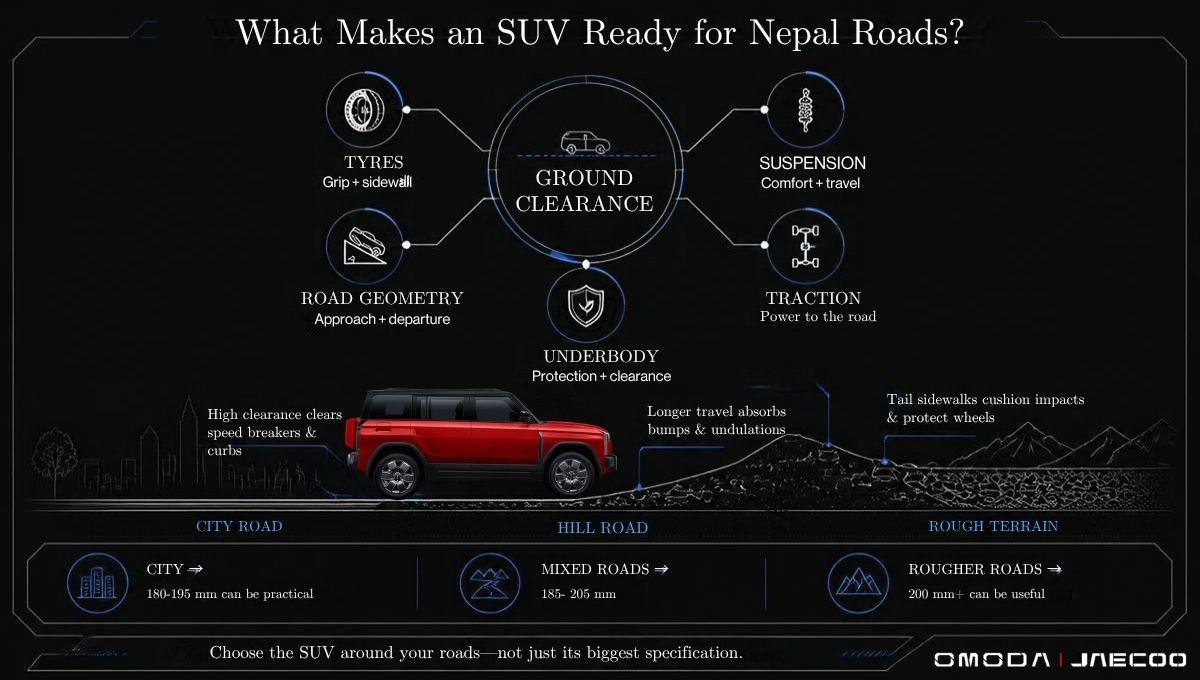
Ground clearance is the distance between the road and the vehicle's lowest point.
For Nepal's roads, that space can be useful when dealing with:
Potholes and broken surfaces
Uneven speed breakers
Steep ramps and road transitions
Gravel and unpaved sections
Rough hill roads
Monsoon waterlogging
Higher clearance can provide more room for the vehicle's underbody and obstacles. But ground clearance is not the only factor that makes an SUV good off-road.
Suspension travel, tyre size, approach / departure angles, wheelbase, traction and protection of the underbody can all have a real-world effect.
This is why we recommend you see the whole picture, not just the ground clearance number when deciding on an SUV.
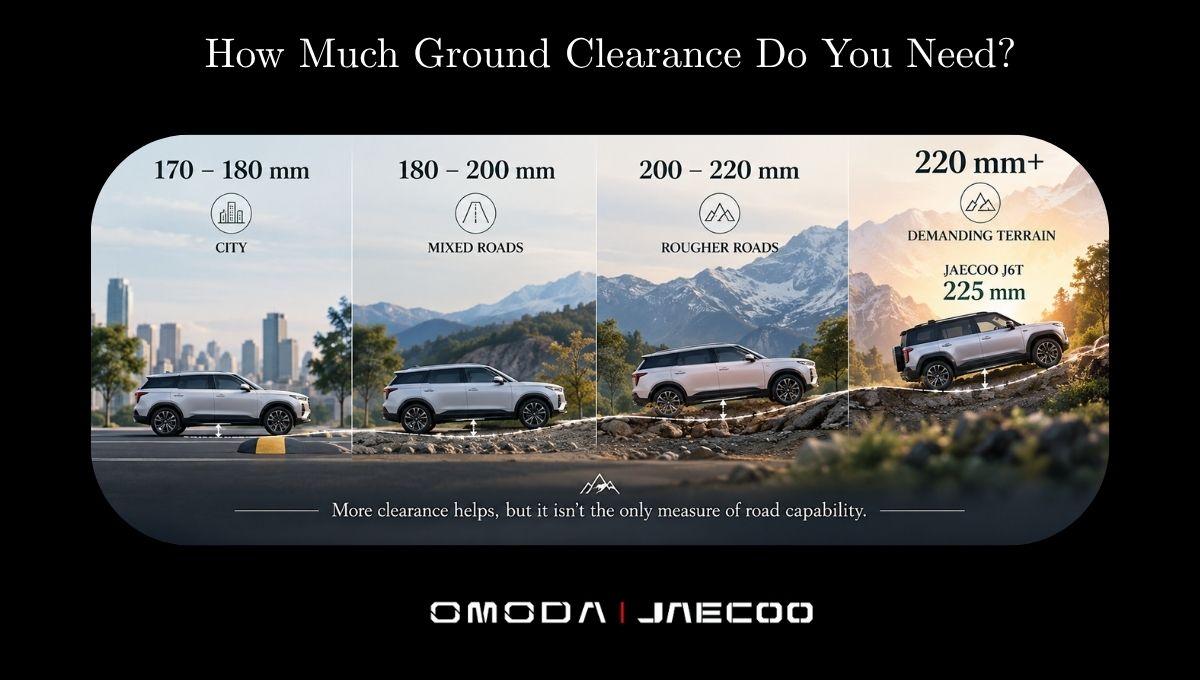
There's no one-size-fits-all ideal figure for all drivers.
As a guide to practice:
|
Ground clearance |
Suitable use |
|
170 to 180 mm |
Mostly urban driving |
|
180 to 200 mm |
City, highway and mixed roads |
|
200 to 220 mm |
Frequent rough and hilly roads |
|
220 mm and above |
More demanding terrain |
This is practical advice on buying rather than engineering requirements.
For those who spend most time in Kathmandu, an SUV with approximately 180 to 190 mm of clearance can offer a good compromise between clearance and comfort. If rough surfaces, steep roads or uneven terrain are on your regular routes, the more clearance you have, the more underbody margin you have.
If you want more information, check out our article on the importance of ground clearance in an electric SUV.
Several premium electric SUVs available in Nepal now offer more than 200 mm of ground clearance. The JAECOO J6T has a current automotive coverage of 225 mm.
Rather than picking one SUV as the best, it's better to know where they fit.
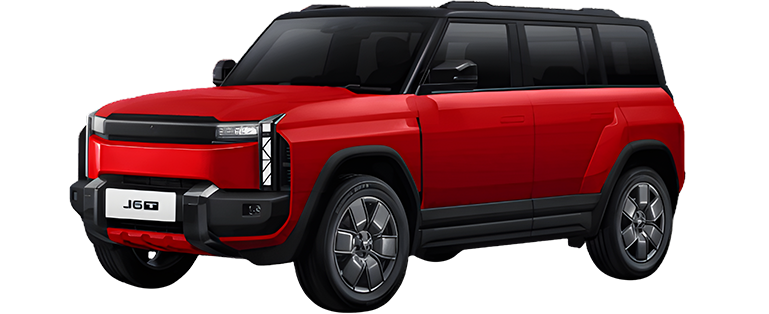
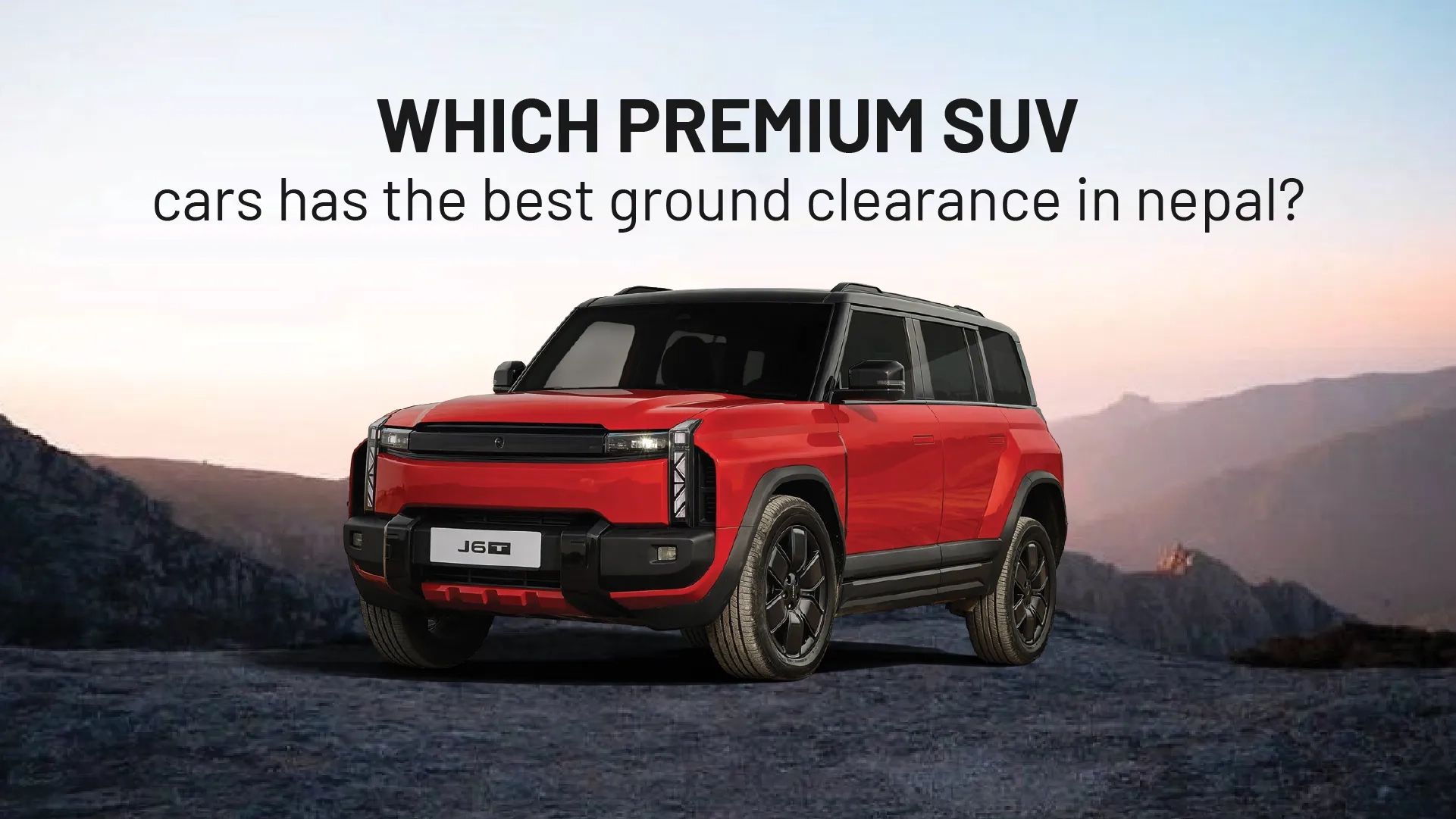
With 225 mm of ground clearance, the JAECOO J6T has the highest clearance among the OMODA & JAECOO electric SUVs discussed here.
The J6T combines its clearance with a 65.69 kWh CATL LFP battery, 135 kW rear motor, 220 Nm torque, 431 km claimed range, and 130 kW DC fast charging. It also has a listed 625 mm water wading capability, nine intelligent driving modes, and up to 55 percent gradient capability.
The specifications are important to us because clearance is more useful when it's supported by other specifications developed for uneven and difficult roads.
Our current official OMODA & JAECOO Nepal price page lists the J6T at NPR 71,99,000.
Also you can read: JAECOO J6T Off Road Guide for Nepal's Rough Roads and Monsoon
This is a good example of how the largest does not necessarily mean the best choice for an SUV.
The JAECOO J5 has 185 mm of ground clearance and up to 461 km of claimed range, while the J6T has 225 mm and a claimed 431 km range.
So, the two vehicles have two different priorities.
The J5 might appeal to owners who value:
The J6T is more relevant when you regularly priorities:
We see this as something that is decided based on the different driving needs, and not just a specification contest.
Check out our comparison of the JAECOO J5 and J6T and see if you can find a better SUV for your family and lifestyle.
Not necessarily.
An SUV can have more clearance over obstacles, but there are other factors that affect its road capability.
Suspension provides the ability to control the vehicle on uneven surfaces.
Tyres relate to grip, comfort, and response to rough road surfaces.
Vehicle geometry matters when approaching steep ramps, dips, and uneven surfaces.
Underbody protection is particularly important when components sit close to the road.
Traction becomes increasingly relevant on loose, wet or steep surfaces.
This is why an SUV with slightly less clearance can still be the better fit for one driver, while a higher clearance model may make more sense for another.
This is particularly important during Nepal's monsoon.
Ground clearance tells you how far the vehicle's lowest point sits above the ground.
Water wading capability is a separate manufacturer with specified capability for travelling through water under defined conditions.
For example, the JAECOO J6T has 225 mm of ground clearance and a listed 625 mm water wading capability. The JAECOO J5 is listed with 185 mm clearance and 450 mm wading capability.
Neither figure should be treated as a guarantee that driving through floodwater is safe.
Water depth, current, road surface, hidden potholes and debris can all create serious risks.
We recommend checking the road before entering standing or moving water and following the manufacturer's guidance.
Read also: Ground Clearance for Waterlogged Roads in Nepal: A Monsoon SUV Guide
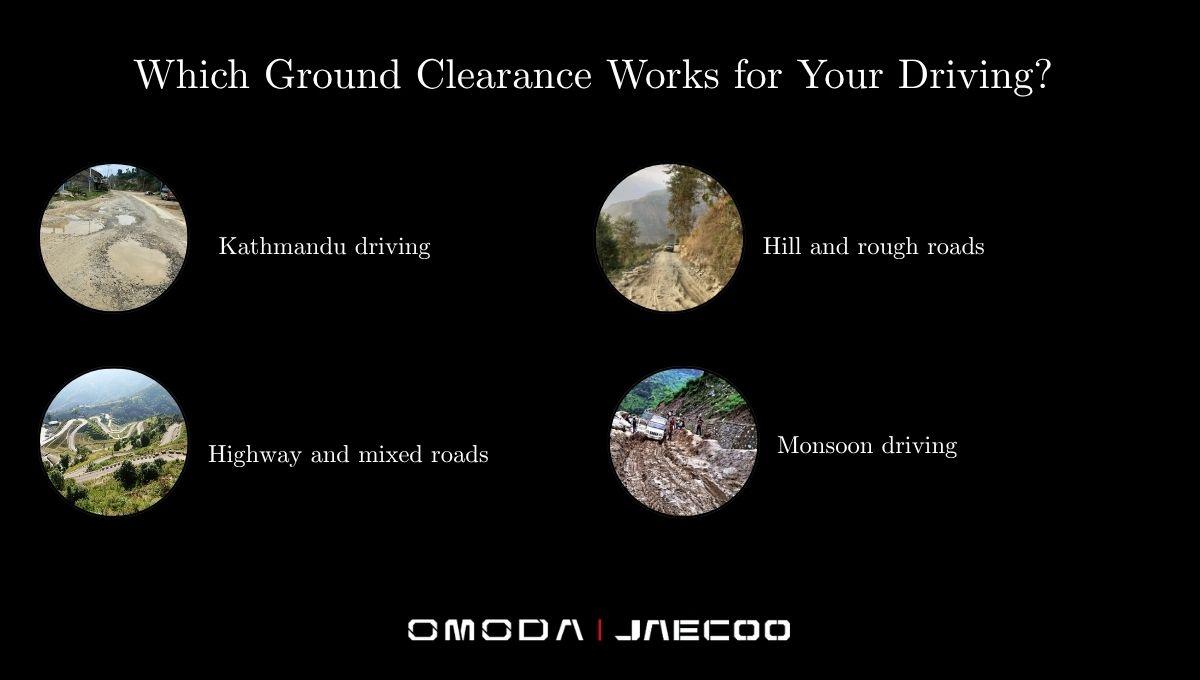
If most of your driving is within Kathmandu, look for a balanced SUV with enough clearance for speed breakers, potholes, and ramps. Around 180 to 190 mm can be practical for many urban users.
For regular highway travel, around 400–450 km of claimed range can be a practical benchmark, but clearance should also be considered alongside suspension comfort, tyres, and charging convenience.
If rough roads are a regular part of your route, 200 mm or more can become increasingly useful. Also check suspension, traction and vehicle geometry.
Do not judge monsoon capability by ground clearance alone. For Nepal’s wet-season conditions, around 400–500 mm of water-wading capacity can offer useful practicality, while 600 mm or more provides greater confidence for deeper water. Tyres, traction, sealing, and actual road conditions remain equally important.
Before deciding, we recommend checking:
For an electric SUV, charging access should also be part of your decision, particularly if you regularly travel outside Kathmandu.
You can check our latest OMODA & JAECOO prices in Nepal to compare the current lineup before making your shortlist.
At OMODA & JAECOO Nepal, we understand that not every buyer needs the same type of SUV.
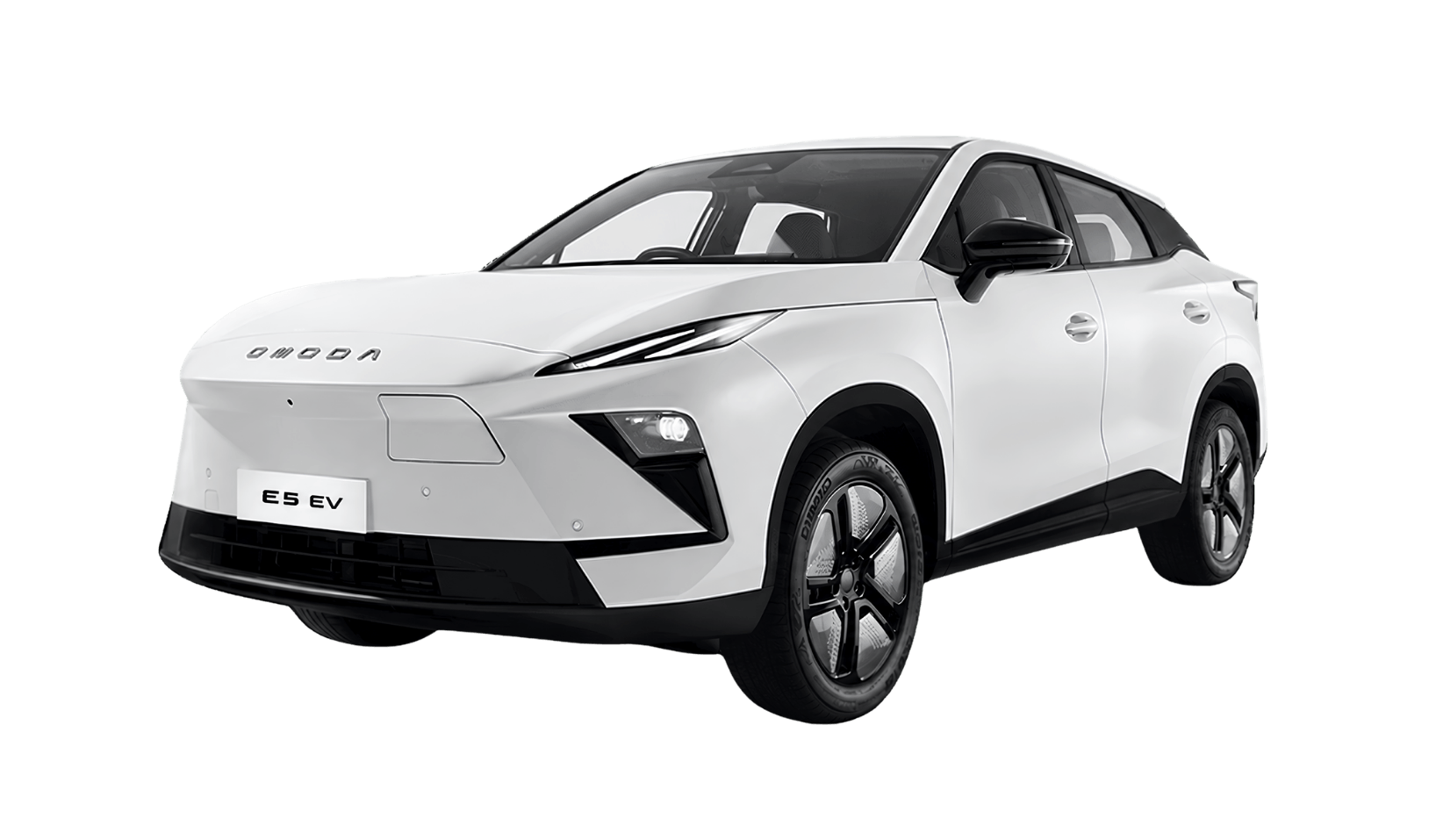
Our OMODA E5 Pro offers 191 mm of ground clearance and is designed around everyday premium electric SUV use. The current official price starts at NPR 51,99,000 for the single tone version.
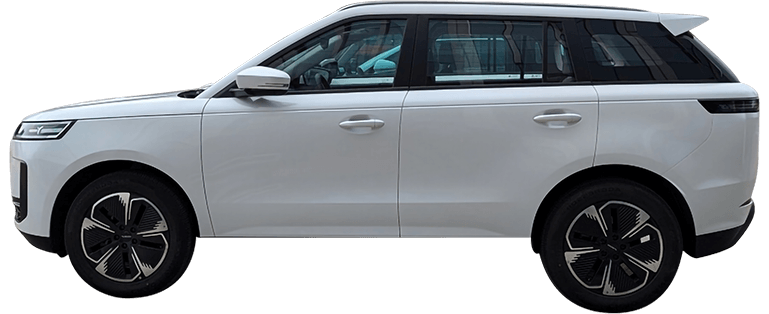
The JAECOO J5 provides 185 mm clearance, a 58.9 kWh CATL LFP battery and up to 461 km of listed range. It is currently priced at NPR 56,99,000.
For buyers who want more clearance and greater terrain focused capability, the JAECOO J6T offers 225 mm of clearance, 625 mm listed water wading capability, and a 431 km claimed range. Its current official price is NPR 71,99,000.
We also offer the JAECOO J5 Pro at NPR 51,99,000, with 185 mm ground clearance and a 405 km claimed range.
For many urban and mixed road users, around 180 to 190 mm can be practical. Drivers who regularly use rough or hilly roads may benefit from 200 mm or more.
Among the models discussed here, the JAECOO J6T has 225 mm of ground clearance.
It can be suitable for many city, highway and mixed road conditions. The right choice depends on your regular routes and the condition of the roads you use.
Higher clearance can provide more underbody space on uneven or partially waterlogged surfaces, but it does not make floodwater safe to drive through. Water depth, current, and hidden obstacles must also be considered.
Suspension, tyres, vehicle geometry, traction, underbody protection, water wading capability and driving conditions all matter.
The best ground clearance SUV in Nepal is not simply the one with the biggest number. It is the SUV whose clearance and overall engineering fit the roads you actually drive.
For everyday Kathmandu use, around 180 to 190 mm may be enough for many drivers. For frequent hill and rough road travel, greater clearance can provide useful additional margin.
At OMODA & JAECOO Nepal, we offer different SUV characteristics for different driving needs. We encourage you to compare the clearance, range, charging, comfort and capability together before making your decision.
Want to find the right fit for your roads? Explore our latest prices, compare our electric SUVs, or book a test drive with us and experience the difference on the road.