Things To Know Before Buying EV Car in Nepal
October 12, 2026
Things To Know Before Buying EV Car in Nepal
October 12, 2026
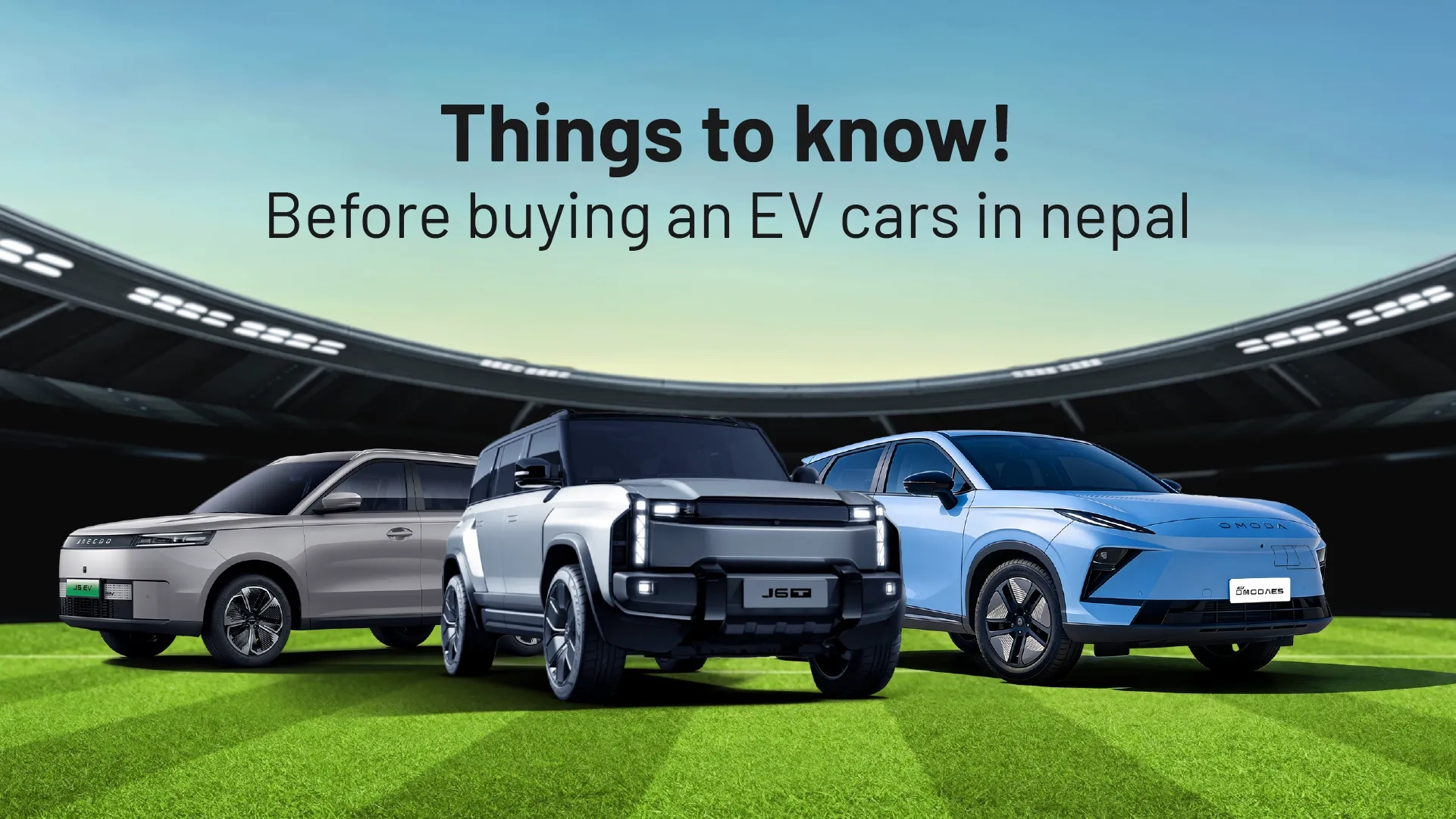
Buying an EV in Nepal is about more than comparing price, range and features.
You must find out if it will suit your daily driving, charging requirements, roads, and long-term ownership budget before booking one.
The right EV should not only be a good fit in a showroom, but also in Kathmandu traffic, on a highway trip and after years of ownership.
Here are the key things to check before buying an EV in Nepal.
Key Takeaways
Start with your driving needs. Consider your daily distance, regular routes, passengers, and long-distance travel.
Don't treat claimed range as real-world range. Traffic, hills, speed, air-conditioning, load and driving style affect efficiency.
Check the charging before you buy it. Make sure home charging is practical and understand the EV's AC and DC charging capability.
Consider Nepal's roads. Ground clearance, tyres, suspension and safety matter alongside battery capacity.
Evaluate the importer too. Warranty, service coverage, genuine parts, and EV-specific support can shape your ownership experience.
The first question is simple: what will you actually use the EV for?
The requirements of a Kathmandu commuter can be very different from those of someone who drives regularly to Pokhara, Chitwan, Butwal or other hilly and highway routes.
Before comparing models, consider:
Your average daily kilometres
How often you travel outside the city
Number of passengers
Luggage requirements
City vs highway driving
Regular hill or rough-road travel
This is a better basis for selecting an EV than the fact that it boasts the longest advertised range.
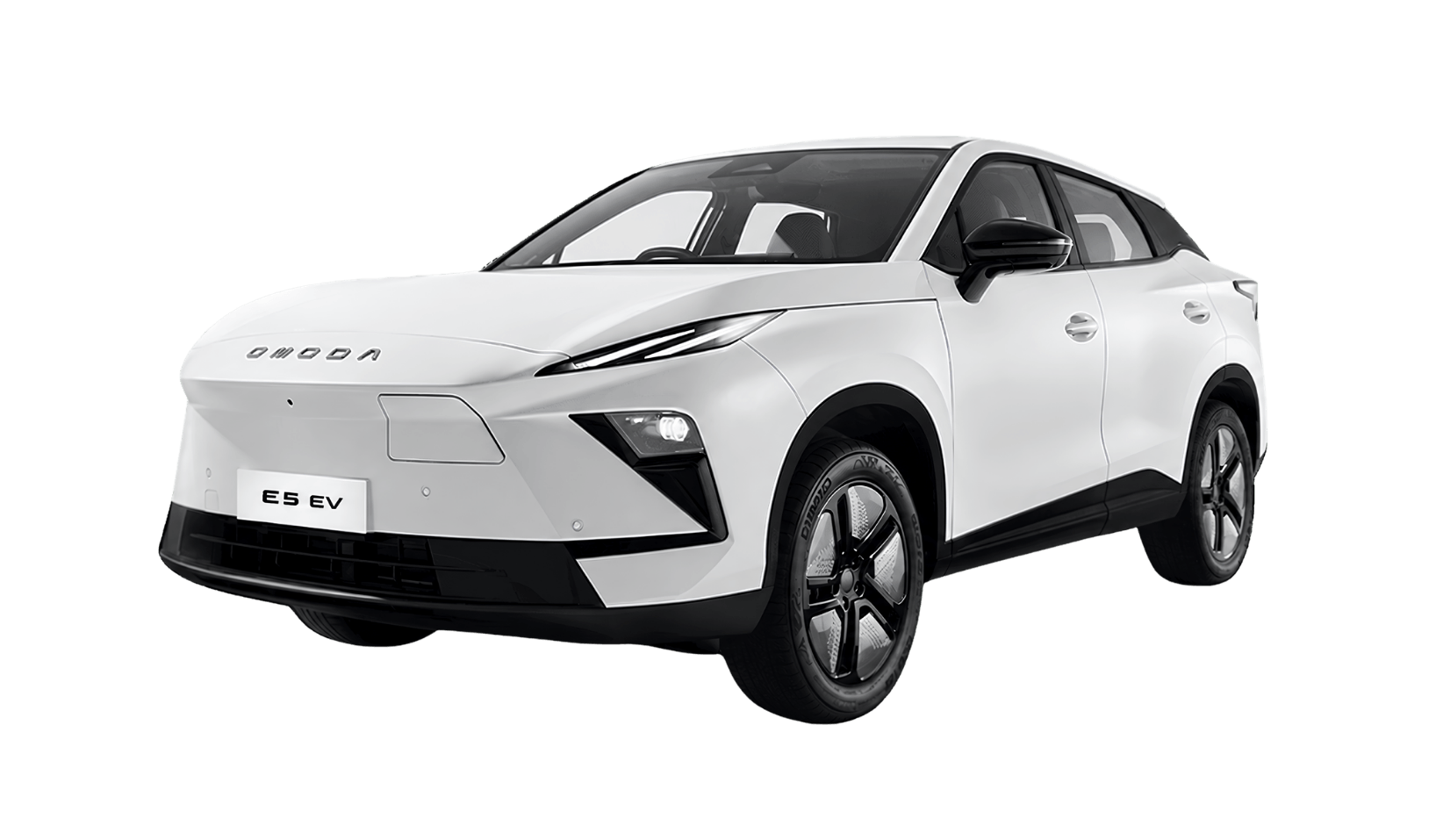
For example, the OMODA E5 Pro uses a 50.7 kWh LFP battery and offers up to 350 km WLTP range. The actual range will still be dependent on how and where you drive.
Our OMODA E5 Pro range guide explains how traffic, hills, air-conditioning, load and driving style can affect EV range.
A published range figure can be helpful to compare vehicles, but it is not a promise of the distance you will cover each charge.
Energy consumption can vary with Kathmandu traffic, elevation, speed, road conditions, climate, and air-conditioning and driving styles.
Therefore, rather than asking:
“What is the longest range of the EVs?”
ask:
How much range do I actually need for my normal routes?
An urban commuter, primarily driving around Kathmandu, might prioritize charging convenience and efficiency over a very large battery.
If you're someone who travels between cities on a regular basis, you'll want to pay more attention to range and quick charging.
Owning an EV with home charging can be a lot easier.
Before buying, check:
Whether you have dedicated parking
Whether your electrical connection can support charging
Where a wall box can be installed
Check with apartment rules if it is permitted to install.
The vehicle's AC charging capability
When traveling longer distances, also consider DC fast charging and availability of charging stations on regular routes.
Fast charging is useful only when compatible charging infrastructure is available where you need it.
Our EV charging cost guide for Nepal explains home, NEA public and private DC charging. You can also check our EV charging stations.
Battery capacity is an indicator of how much energy an EV can store, but battery chemistry is also important.
LFP and NMC are two common lithium-ion battery chemistries. LFP typically has excellent cycle life and thermal stability, and NMC has a higher energy density.
When buying, however, chemistry is not the only factor to take into account. Check the battery management system, warranty, charging habits and manufacturer support as well.
The important question is not just “How big is the battery?” but “Is the entire battery system appropriate for my usage?”
Nepal's roads make ground clearance an important consideration.
Potholes, speed breakers, steep ramps and uneven road surfaces can expose the underside of a vehicle to impact.
However, clearance is not the only factor to consider when judging a road's suitability. Also consider:
Tyre size and sidewall
Suspension setup
Underbody protection
Vehicle dimensions
Braking/Stability systems
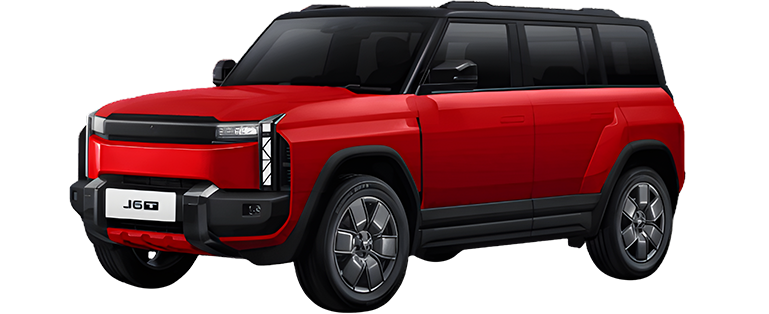
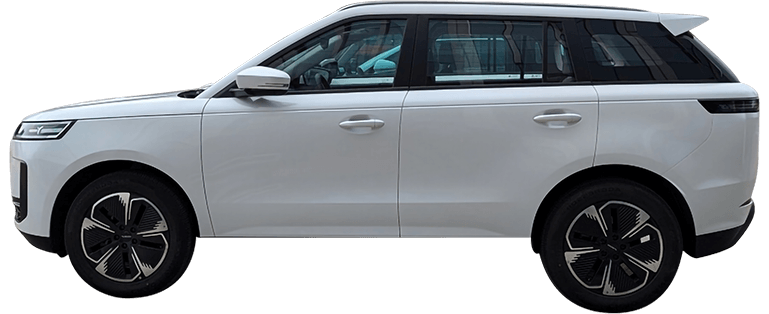
For example, the OMODA E5 Pro is listed with 191 mm ground clearance, while the JAECOO J5 has 185 mm and the JAECOO J6T has 225 mm.
Our guide for ground clearance in Nepal for electric SUVs will give you all the reasons why you should think about ground clearance along with tyres and suspension and the actual road conditions.
One of the most crucial considerations before purchasing an EV is the warranty.
Don't look only at the number of years. Check:
Warranty duration
Kilometre limit
Covered components
Exclusions
Servicing requirements
Approved parts
Claim procedure
The traction battery and the drive motor are both guaranteed for 8 years/180,000km and 8 years/160,000km or until the car is disposed of whichever is first. The extended service includes 11 years/240,000 km battery and 11 years/200,000 km drive motor (applicable terms apply).
See our OMODA & JAECOO extended warranty programme for the applicable conditions.
Warranty does not equal insurance.
Check with your insurer or dealer how your motor insurance policy treats the battery before you purchase it. Review covered incidents, exclusions and claim conditions; request them on paper.
Don't assume that comprehensive insurance protects against all forms of battery damage.
Your relationship with the importer does not end when you leave the showroom.
Before booking, ask:
What is my closest authorized service center?
Are genuine spare parts available?
Are technicians able to diagnose systems related to the EV?
How does a warranty claim work?
Is roadside assistance available outside of Kathmandu?
At OMODA & JAECOO, we have service locations such as Bhaktapur, Biratnagar, Birgunj, Birtamode, Butwal, Dang, Dhangadhi, Itahari, Nepalgunj, Pokhara, Surkhet and Sitapaila.
Our official service page also includes information about the availability of genuine parts at authorised service centers as well as the provision of EV roadside assistance.
Check the latest OMODA & JAECOO service network before visiting a dealership.
Showroom price is just the base price.
Also consider:
Insurance
Home-charger installation
Electricity
Scheduled servicing
Tyres
Financing
Applicable taxes and registration costs
The current official price page lists:
|
Model |
Current listed price |
|
OMODA E5 Pro |
NPR 51,99,000 |
|
OMODA E5 Pro Dual Tone |
NPR 52,39,000 |
|
OMODA E5 |
NPR 56,99,000 |
|
OMODA E5 Dual Tone |
NPR 57,39,000 |
|
JAECOO J5 Pro |
NPR 51,99,000 |
|
JAECOO J5 FWD |
NPR 56,99,000 |
|
JAECOO J6T |
NPR 71,99,000 |
These are the prices currently displayed on our official price page. Prices and offerings may vary; check the current price before booking.
Check the latest OMODA & JAECOO EV prices.
Another cost of ownership to consider is charging. Our current estimates put home charging at approximately NPR 406–723 per full charge, depending on the model and charging conditions.
The taxes and government policies for EVs may impact the actual cost of purchase.
When booking, ensure you receive the correct tax conditions and applicable duties and final price for your selected model for the current fiscal year as opposed to checking an article or price list from a previous year.
To the buyer, the on-road price is a key number.
Also read: EV Tax in Nepal: Its Trends and Impact
Just because the vehicle has a long list of features doesn't necessarily make it safe.
Look for relevant systems such as:
Airbags
Electronic stability control
Automatic emergency braking
Forward-collision warning
Lane-assistance systems
Blind-spot monitoring
Parking cameras and sensors
Then test-drive the EV on roads similar to those you normally use.
Pay attention to:
Ride comfort
Braking feel
Regenerative braking
Steering
Visibility
Turning radius
Seating
Rear-seat space
Parking assistance
The ten-minute showroom drive does not give you much information and insight into suitability.
EVs have fewer moving parts than petrol vehicles, but they are not maintenance-free.
There is still work to be done on battery systems, cooling, tyres, brakes, suspension, electrical components, and software.
OMODA & JAECOO recommends servicing every 10,000 km or 12 months, whichever comes first. An annual estimate of battery-maintenance cost around NPR 5,000 – 10,000 is also available from the official service network, for battery-health, wiring, and cooling-system checks.
See our OMODA & JAECOO maintenance guide for more ownership details.
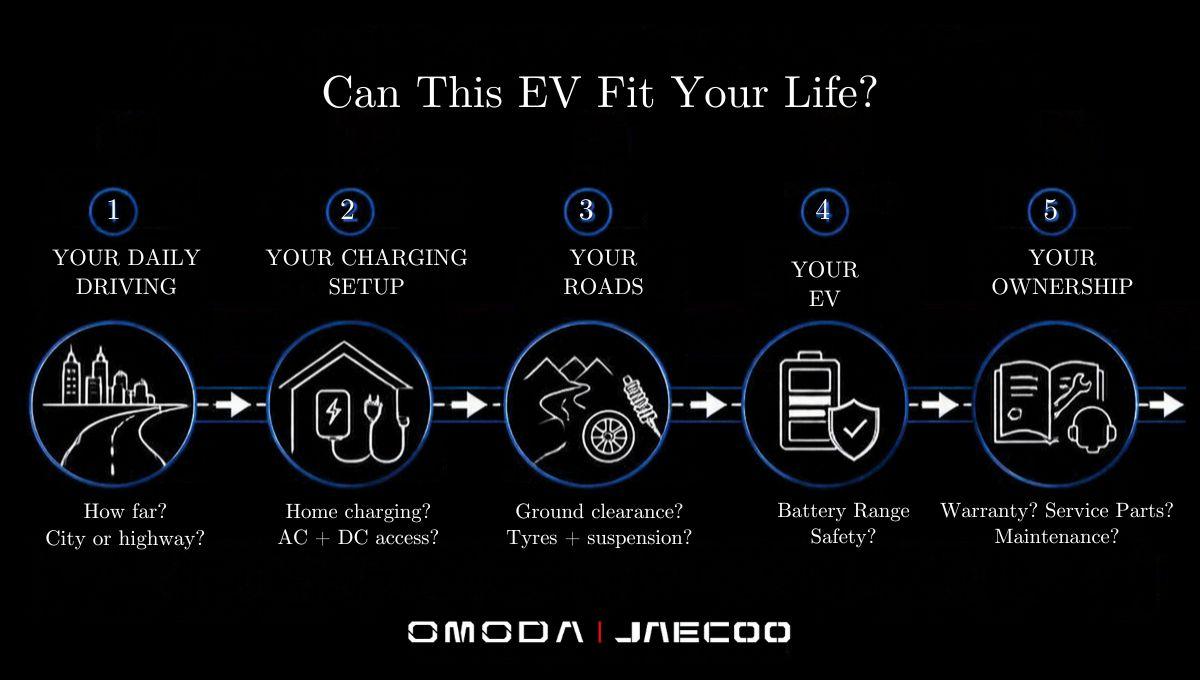
Avoid leaving the showroom with questions unanswered. Double-check these five things before you book:
If you can answer these five questions clearly, you're comparing EVs based on ownership, not just showroom specifications.
Start with your driving pattern and charging situation. Then compare real-world range, road suitability, warranty, service support, safety and total ownership cost.
There is no universal figure. Your daily distance, highway travel, hills, traffic and charging access should determine how much range you need.
Not necessarily, but it can make daily ownership much easier. Check your parking and electrical setup before buying.
Compare years and kilometres, then read the exclusions, servicing requirements and claim conditions. A longer warranty headline does not necessarily mean broader coverage.
Yes, particularly if you regularly encounter potholes, speed breakers and uneven roads. However, clearance should be considered alongside tyres, suspension and braking.
Both matter. A lower purchase price may not mean lower ownership cost if service, parts or warranty support are difficult to access.
The right EV for Nepal is not necessarily the one with the biggest battery, longest claimed range or longest feature list.
It is the one that fits the way you drive, where you charge, the roads you use, and the ownership cost you can comfortably manage.
That is how we approach EV ownership at OMODA & JAECOO Nepal.
Alongside our growing electric SUV range, we provide authorized service support, genuine parts, structured warranty coverage and practical ownership information for buyers in Nepal.
If you are narrowing down your options, start with our current OMODA & JAECOO EV prices, check the service network and explore our EV buying guides.
Then visit an authorized location, take a proper test drive, and ask the five questions above before you book.
Because the best time to find out whether an EV fits your life is before you buy it, not after.