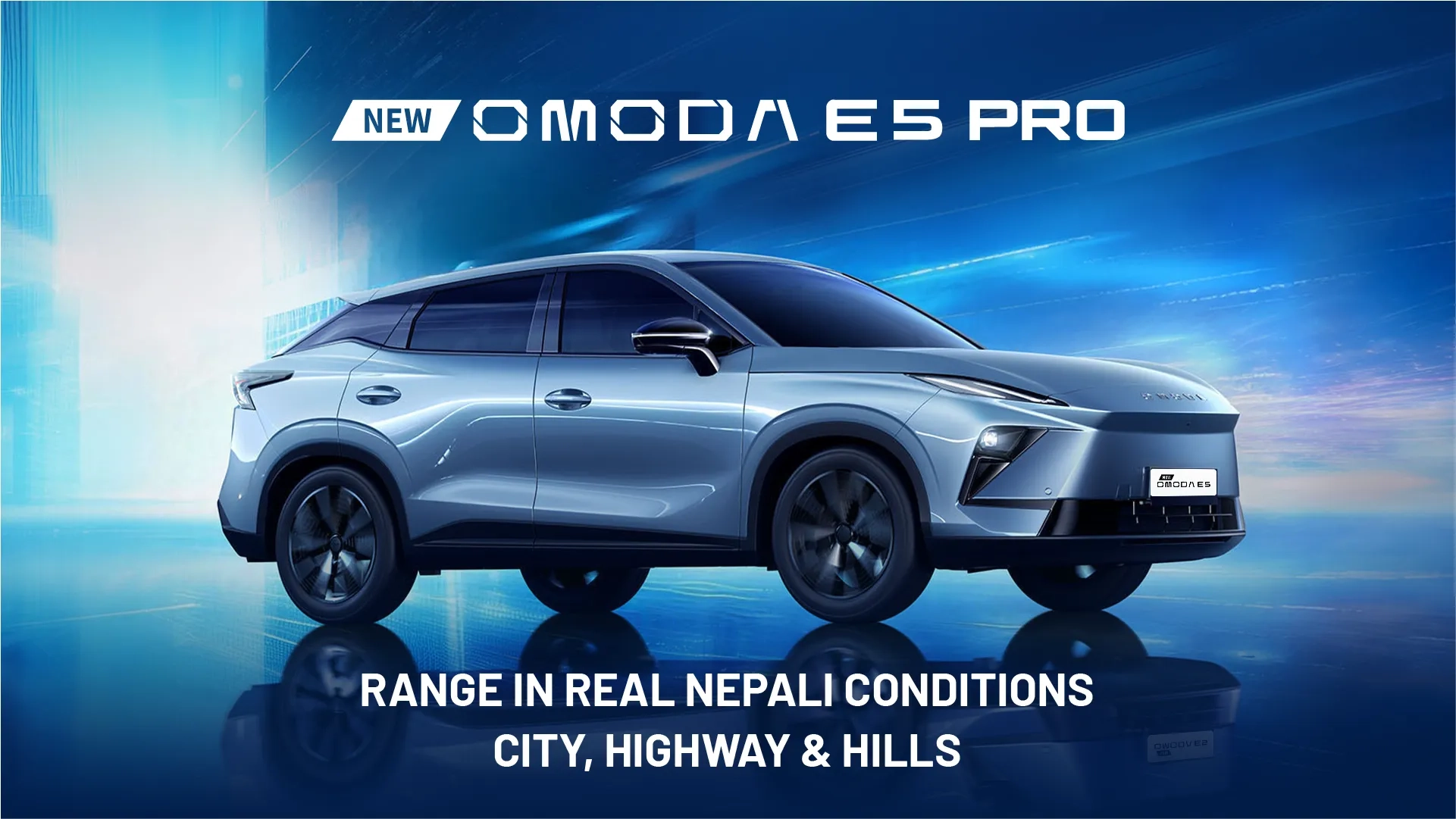
Omoda E5 Pro Range in Real Nepali Conditions: City, Highway & Hills
September 18, 2026
Omoda E5 Pro Range in Real Nepali Conditions: City, Highway & Hills
September 18, 2026
Omoda E5 Pro offers up to 350 km WLTP range, while a Nepal road test estimated around 330 km in real-world conditions.
Kathmandu traffic, highway speed, hills, AC, load, and driving style can affect actual EV range.
Its 50.7 kWh LFP battery, 191 mm ground clearance, and regenerative braking suit varied Nepal roads.
110 kW DC fast charging and home charging support make longer trips more practical.
For Nepal, plan around real-world range, charging availability, and route conditions, rather than the maximum WLTP figure alone.
One of the primary concerns that will come to mind when you are considering an EV is how far it can go on a single charge. The official Omoda E5 Pro range is up to 350 km from WLTP. WLTP is a standardized test result, so real-world range can vary on Nepal's roads.
The Omoda E5 Pro real range can be influenced by Kathmandu traffic, highway speed, elevation changes, downhill regeneration, air-conditioning, passengers, weather and road conditions.
The best Nepal-specific reference currently available is a published Kathmandu–Pokhara road test. Meroauto tested the E5 Pro for 203 km using 51% battery and estimated the E5 Pro to have a real-world range of approximately 330 km on Nepali roads. It's a helpful real road reference but should not be considered a standard range for all drivers and all routes.
The easiest way to understand the Omoda E5 Pro driving range is to separate its official WLTP figure from real-world driving.
|
Range factor |
What it means |
|
Official WLTP range |
Up to 350 km |
|
Published Nepal road-test reference |
~330 km estimated |
|
Test route |
Kathmandu to Pokhara |
|
Distance covered |
203 km |
|
Battery used |
51% |
The current Nepal specification lists a 50.7 kWh LFP battery, 99 kW motor, 288 Nm maximum torque, 191 mm ground clearance, 6.6 kW AC charging and up to 110 kW DC fast charging.
So, when comparing electric SUV range in Nepal, the clearest distinction is between the official WLTP figure and real-world testing: the E5 Pro is rated for up to 350 km WLTP, while Meroauto's Kathmandu–Pokhara test estimated around 330 km under its test conditions.
That's important because the EV range is impacted by driving habits, location, and time.

The Omoda E5 Pro city range can benefit from regenerative braking.
The average speeds and frequent stops in Kathmandu and Lalitpur allow for some energy to be recovered through regenerative braking. However, stop-and-go traffic does not automatically mean maximum efficiency, because long periods of congestion with the AC running can still consume significant energy.
The AC can be a factor in high energy use if it is used in traffic for a long time, accelerated frequently, driven through steep urban sections, carrying heavy loads of passengers, and frequent short trips.
If you're looking for a commuter vehicle, the E5 Pro's range should be evaluated in conjunction with the distance you'll cover on the average day. Depending on driving conditions and battery reserve, the range of the vehicle may be adequate for the driver to drive 30–40 km per day for several days without recharging.
Home charging can also reduce range anxiety for urban owners. You can recharge at night and get away with a higher battery level when it's time to head out the door again instead of waiting for a public charger.
The Omoda E5 Pro highway range is quite dependent on speed.
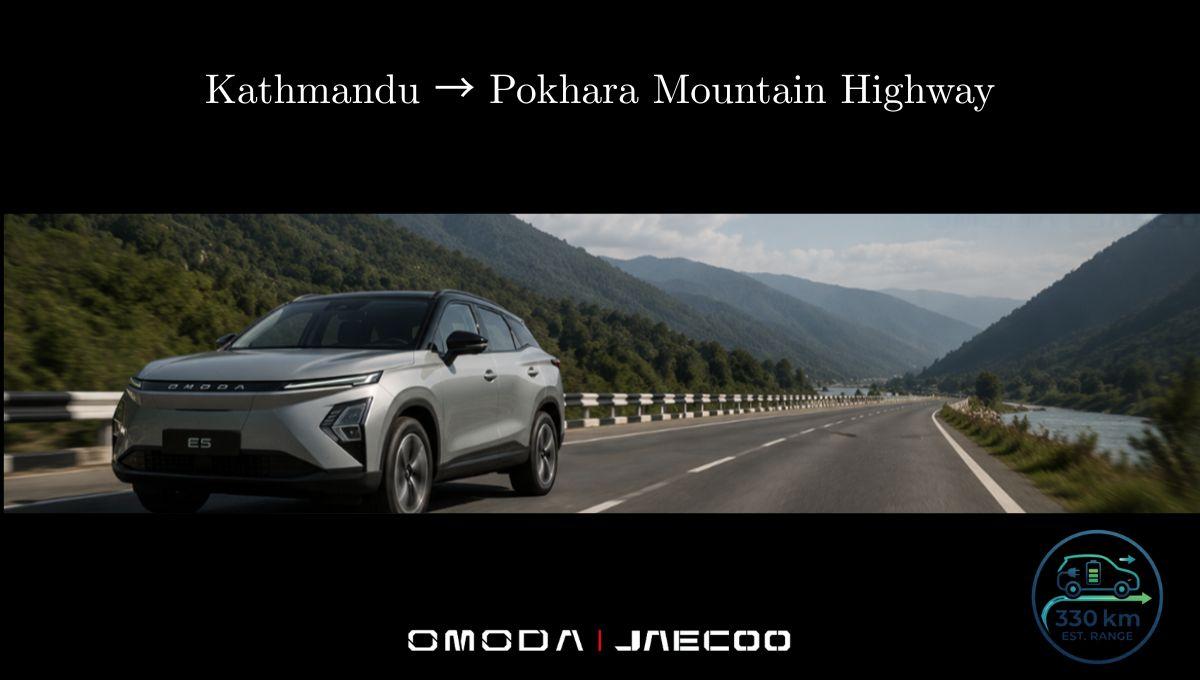
When traveling at higher speeds, the aerodynamic resistance increases, so normally more energy is used. This is why cruising is the more efficient way to complete a trip than accelerating and braking hard several times.
This is important for trips like Kathmandu-Chitwan, Narayanghat-Butwal on longer highway trips. It is better to plan each trip around a reasonable battery reserve, rather than planning all the trips around the maximum WLTP figure, considering traffic conditions, speed and availability of charging stations.
The test of Kathmandu–Pokhara is especially important, as it involves driving on highways, high altitudes, and rougher roads. The E5 Pro traveled 203 km on a 51% battery charge, and that it does believe the car can cover about 330 km under real-world conditions. It also claimed that the vehicle could navigate rough terrain and steep inclines with ease, and that the DC charging test showed it was able to charge faster than 80 kW.
That's more useful information than just quoting a lab range figure for an EV, for those who are thinking of making a transition from Kathmandu to Pokhara.
The Omoda E5 Pro hill range relies a lot on the change of height and the actual steepness of the hill the vehicle is climbing.
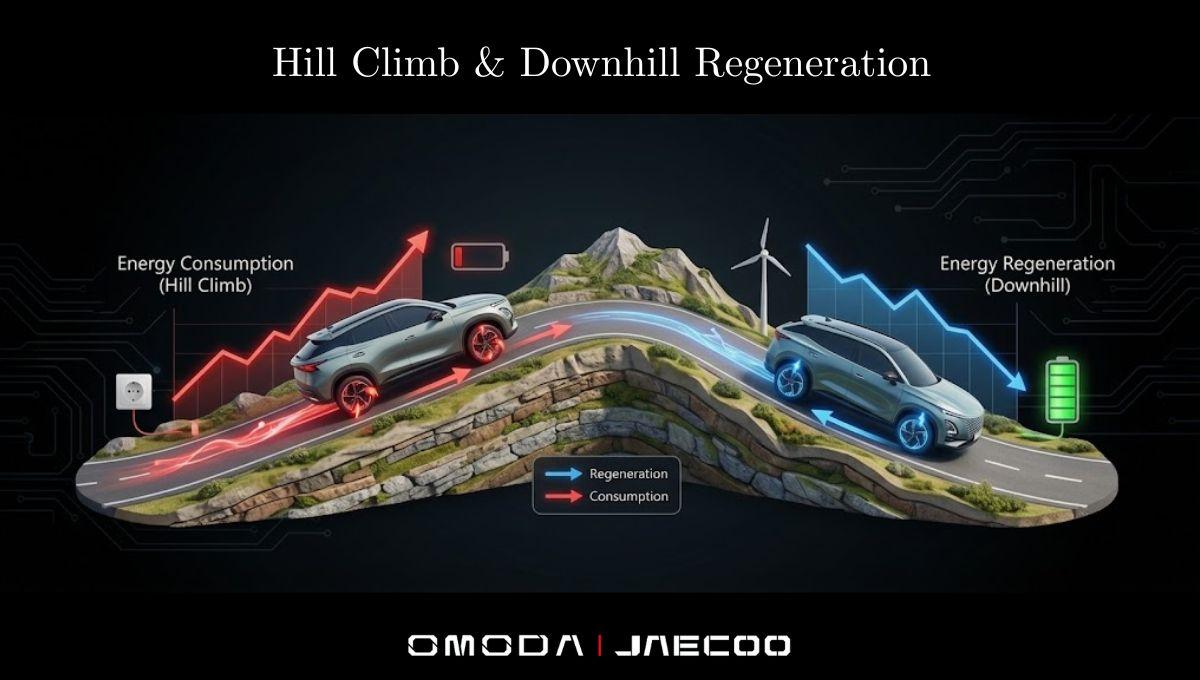
Long up-hill sections require more energy as the motor must push the vehicle uphill against gravity. This means that a higher percentage of your battery might be used while driving up a mountain versus driving relatively flat.
There's also a significant benefit on the other end of the climb: downhill regeneration.
When the vehicle is slowing down or descending, some of the kinetic energy can be converted back into electrical energy and stored in the battery as regenerative braking. It can't recover all of the energy used on the climb, but it can be more efficient on a route that includes a lot of climbing.
The 191 mm of ground clearance gives the E5 Pro practical ground clearance for uneven Nepal roads, and its published powertrain specification is 99 kW, 288 Nm of torque.
When planning a trip in the mountains, it is better to plan conservatively than to assume the maximum WLTP range will stay the same for the duration of the trip.
There are a number of regular conditions that impact your Omoda E5 Pro battery range.
Speed: Higher speeds generally increase energy consumption.
Elevation: Long descents can regain power through regeneration, but long climbs need more power.
Traffic: Regenerative braking can aid in deceleration; however, at times of heavy traffic with climate control in use, electricity is consumed anyways.
Climate control: AC and heating create electrical demand, especially if used continuously during extreme weather.
Passenger and luggage load: Additional weight requires more energy to move the vehicle.
Driving style: Smooth acceleration, steady speeds and controlled regenerative braking can improve EV efficiency.
This is the reason why EV range in Nepal and electric-car mileage varies in different trips even if the battery level is the same when the car is powered on.
The Omoda E5 Pro real range is mainly about optimizing driving and not about driving at a below-average speed.
Keep your speed steady on the highway, use smooth acceleration/ deceleration, monitor tyre pressure, and perform smooth regenerative braking. When on extended hill trips, plan for a responsible battery supply for the traffic, detours and unexpected delays.
Everyday EV ownership can also be facilitated with home charging. Overnight charge allows you to start the day with a full battery, especially helpful for commuters.
When considering a long-range EV in Nepal, this blend of range, charging infrastructure and smart driving is more relevant than the advertised range.
Range and charging infrastructure should be looked at as a single unit.
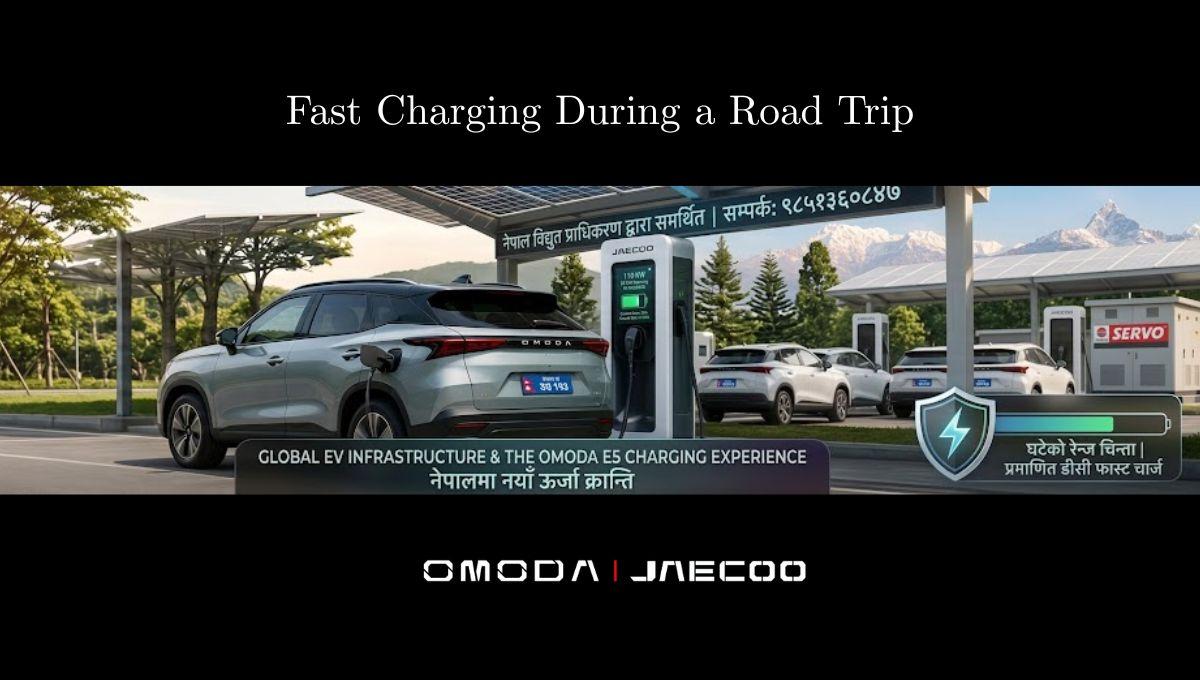
The E5 Pro is equipped with a CCS2 fast charging connector that delivers up to 110 kW DC fast charging and 6.6 kW AC charging.
The charging time when it is connected to AC is about 3 to 4 hours to reach 30% to 80% charge, and 30% to 80% charge takes about 40 minutes to 45 minutes when it is charged at fast charging speed as per the condition of charging.
Charging stops are also indicated at regular intervals along major roads and in major cities, and charging support is included in our official Nepal specification content, which is intended to highlight this feature.
For longer trips, make sure you know where the charger is before you leave and have enough battery power in case of detours, changes in road conditions or traffic.
This is especially true for trips across highways and mountains.
For buyers looking for a premium electric SUV in Nepal, range is only one part of the ownership decision.
The E5 Pro combines its 50.7 kWh LFP battery and 350 km WLTP range with a 99-kW motor, 288 Nm torque and 191 mm ground clearance. The specification officially states that there are 19+ ADAS systems, 15.6-inch display, 540-degree surround-view camera, 442-litre boot space, and 3.3 kW V2L.
The current official price is NPR 51,59,000 for the Single Tone variant and NPR 51,99,000 for the Dual Tone variant. Both variants have the same basic model and performance, and the difference is mostly in the exterior finish.
That provides the purchasing opportunity to assess the E5 Pro as a whole: range, charging, comfort, safety, technology, road practicality and ownership value.
For the latest pricing, visit our Omoda Jaecoo Nepal pricing page.
The Omoda E5 Pro range in Nepal should be taken as a range benchmark and not a fixed number.
The official Omoda E5 Pro WLTP range is up to 350 km, with the best published real-world measurement being the Kathmandu–Pokhara road test conducted by Meroauto, which covered 203 km on 51% battery usage, and estimated real-world range of ~330 km.
The results can vary due to city traffic, highway speed, elevation changes, AC usage, load and driving style. So, to plan an EV trip in Nepal is to think of the route, battery percentage, driving condition and charging options all together is the right approach.
For us, that's the better way to look at an EV than just how it performs in a test setting, but how it performs in the way that you drive.
Check out the Omoda E5 Pro model, see the current price, or find out more about charging information before your next trip.
The Omoda E5 Pro range in Nepal is dependent on speed, terrain, traffic, climate control, load and driving style. Its official WLTP range is up to 350 km, while Meroauto estimated around 330 km of real-world range from its 203 km Kathmandu-Pokhara test.
There is no separate certification for Kathmandu and Lalitpur for the Omoda E5 Pro city range. Lower speeds and regenerative braking can help with efficiency, but traffic, AC, short distances, and elevation can also impact consumption.
Yes. Uphill driving can use more energy, meaning that mountain routes can shorten the range that can be obtained from a battery charge. Some of the energy can be recovered by downhill regenerative braking.
With proper planning it can be appropriate. The test was conducted from Kathmandu to Pokhara, covering 203 km on 51% battery and with an estimated 330 km range in real-world driving.
Aerodynamic resistance increases with higher highway speeds, which translates to higher energy consumption. Riding in an efficient manner may be more efficient than repeated hard acceleration.
Actual EV efficiency is affected by speed, elevation change, Kathmandu traffic, road surface, AC/heating, passenger load, and driving style.
The current Nepal spec has a 50.7 kWh LFP battery and an official 350 km WLTP range.
The E5 Pro also comes equipped with 6.6 kW AC charging and CCS2 charging up to 110 kW DC fast charging. Omoda Jaecoo Nepal claims around 3-4 hours of charging for 30-80% and around 40-45 minutes of charging for 30-80% fast charging (FC) under different conditions.
Omoda Jaecoo Nepal provides charging support for EV owners and highlights charging availability along major roads and in major cities. Before a long trip, consult up-to-date information on charging.
Yes. With the official WLTP range of 350 km, regenerative braking and home-charging, the E5 Pro is suitable for routine city driving, but actual consumption may vary depending on the driving situation, climate control, road conditions and the driving style.