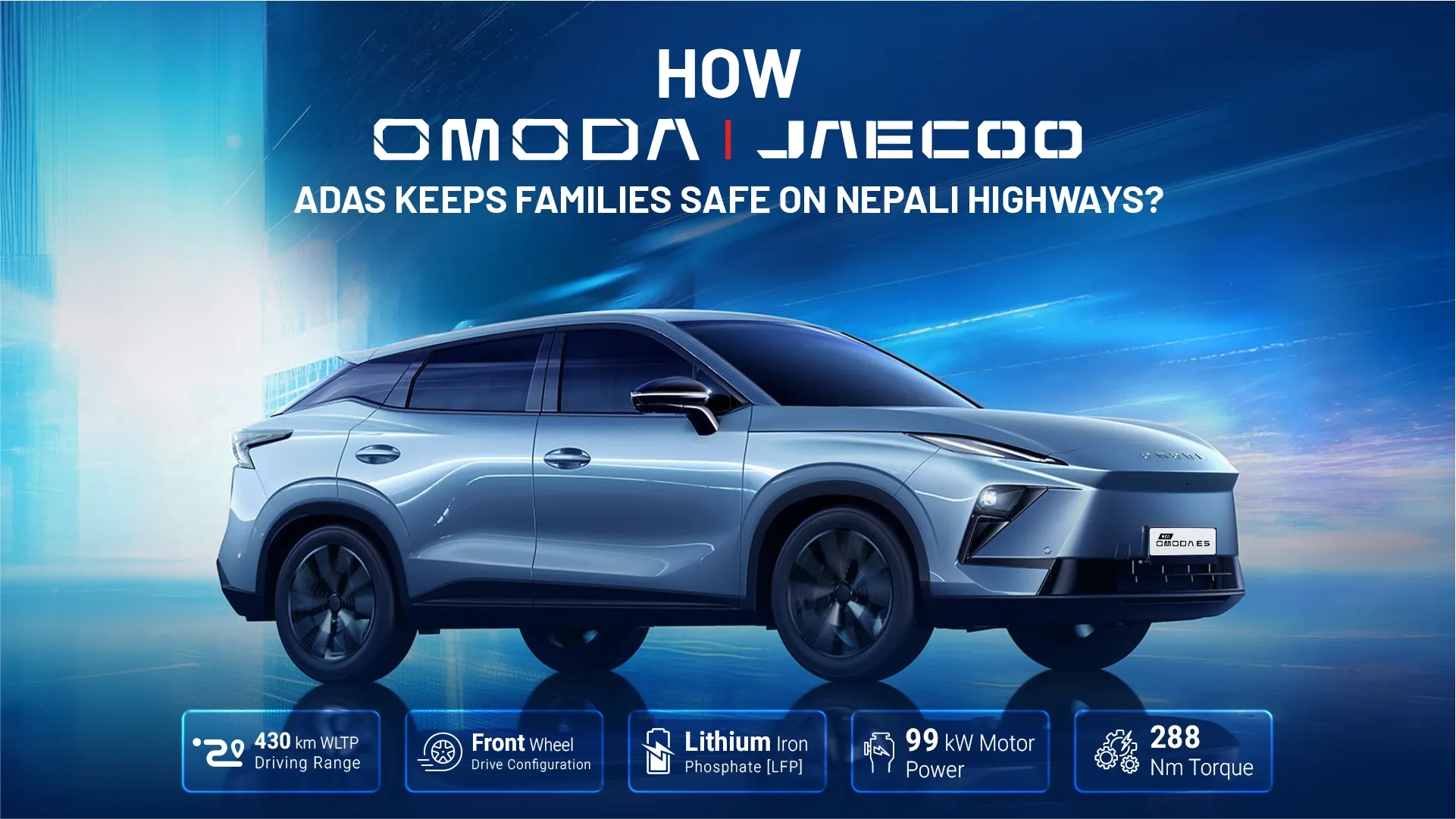
How Omoda Jaecoo's ADAS Keeps Families Safe on Nepali Highways?
September 17, 2026
How Omoda Jaecoo's ADAS Keeps Families Safe on Nepali Highways?
September 17, 2026
Omoda Jaecoo ADAS includes up to 19 advanced driver assistance systems across the E5 Pro, J5 and J6T, with features varying by model.
Adaptive Cruise Control, lane assistance and Traffic Jam Assist can help reduce driver workload during long or congested highway journeys.
AEB, Forward Collision Warning and Blind Spot Monitoring provide additional support during sudden braking, overtaking and lane changes.
The 540° surround-view camera improves visibility during parking, reversing and tight manoeuvring, while other safety equipment complements the ADAS package.
ADAS is a driver-support system, not autonomous driving; its effectiveness depends on road markings, weather, traffic and other operating conditions, so drivers must remain attentive.
A family road trip in Nepal may include changing traffic, motorcycles, pedestrians, sudden braking and the changing road conditions. When driving long stretches on the highway, it can also be challenging to focus for hours.
Omoda Jaecoo ADAS uses cameras, sensors and vehicle-control technology to warn drivers of potential hazards and assist with braking, steering and speed control in specific driving situations.
The specifications of the exact features differ between models, therefore always read the current Nepal specification before booking.
ADAS, or Advanced Driver Assistance Systems, is a group of active safety technologies that assist the driver while the vehicle is moving.
Unlike passive safety equipment such as airbags, ADAS can actively monitor aspects of the driving environment. Depending on the system, it can warn the driver about a potential collision, help maintain a lane position, manage following distance, or apply braking in certain situations.
The Omoda E5 Pro currently lists 19 ADAS systems on its Nepal model page. These include Lane Departure Warning, Lane Departure Prevention, Blind Spot Monitoring, Forward Collision Warning, Automatic Braking System, Adaptive Cruise Control and Traffic Jam Assist.
The Jaecoo J5 offers an L2+ driver-assistance package with functions including Adaptive Cruise Control, Lane Departure Warning, Lane Keep Assist, Autonomous Emergency Braking, Blind Spot Detection, Traffic Sign Recognition and driver-monitoring functions.
The J6T also lists key assistance technologies including Adaptive Cruise Control, Automatic Braking, Blind Spot Monitoring, Forward Collision Warning, Lane Departure Warning, Lane Departure Prevention and Traffic Jam Assist.
For a detailed model-level breakdown, see our Omoda E5 Pro full specifications and ADAS guide.
Forward Collision Warning (FCW) monitors the road ahead and can alert the driver when the system detects a potential forward collision.
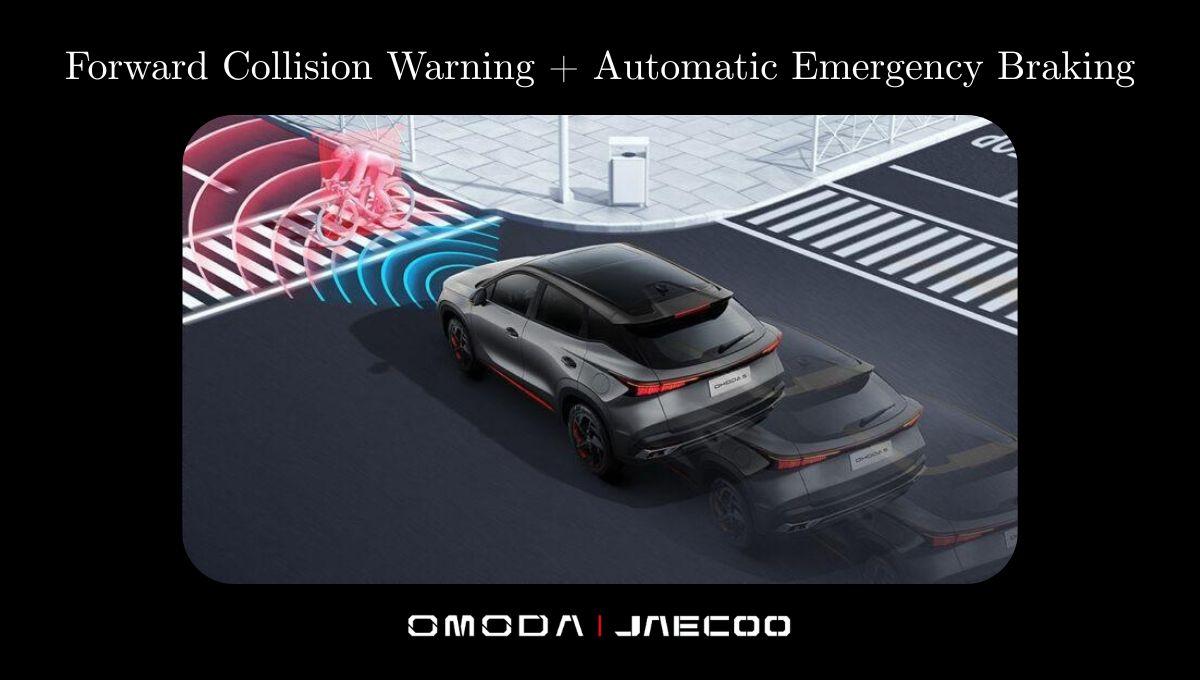
Automatic Emergency Braking (AEB) can provide braking assistance when the system determines that intervention is necessary, and the driver has not responded sufficiently.
On busy Nepali highways, these technologies can offer additional support when traffic slows suddenly or the distance to the vehicle ahead changes quickly.
They do not remove the need to maintain a safe following distance or adjust speed to road conditions.
Lane Departure Warning (LDW) alerts the driver when the vehicle begins to leave a detected lane under applicable operating conditions.
Lane Departure Prevention (LDP) or lane-keeping assistance can provide steering support to help the vehicle remain within its detected lane.
These features can be useful during longer journeys, particularly when concentration becomes more demanding. However, lane-based systems rely on detectable road markings and can be less effective when markings are faded, missing or obscured.
That is particularly relevant to highway driving in Nepal, where road markings and conditions may vary between sections.
Adaptive Cruise Control (ACC) is designed to maintain a selected speed while adjusting the vehicle's speed in response to traffic ahead, within the system's operating conditions.
For long-distance journeys, ACC can reduce some of the repetitive work involved in managing speed and following distance.
For families travelling between Kathmandu and destinations such as Pokhara or Chitwan, this can make steady highway driving less demanding. However, the driver must continue monitoring the road and remain ready to take control.
Highway travel in Nepal does not always mean open roads. Congestion can involve repeated acceleration, braking, and stopping.
Traffic Jam Assist (TJA) is designed to assist with parts of the driving task in low-speed traffic when system conditions are met. The E5 Pro and J6T list TJA among their ADAS functions.
It can reduce some repetitive workload in slow-moving traffic, but it does not allow the driver to stop paying attention.
.jpg)
Overtaking can be challenging when motorcycles, buses, trucks, and smaller vehicles share the road.
Blind Spot Monitoring (BSD/BSW) is designed to monitor areas beside and behind the vehicle that may not be fully visible through conventional mirrors. When another vehicle is detected in a monitored area, the system can provide a warning, depending on the model and operating conditions.
For highway driving, that additional information can help when changing lanes or returning to a lane after overtaking.
Drivers should still check mirrors and blind spots directly. ADAS is an additional layer of awareness, not a substitute for observation.
Traffic Sign Recognition (TSR) can identify certain road signs and provide relevant information to the driver through the vehicle's display where supported.
The current Nepal information for the Jaecoo J5 includes Traffic Sign Recognition as part of its driver-assistance package.
This can provide another source of information when road signs or speed limits change during a long journey. Drivers should continue to observe road signs directly.
Not every safety challenge occurs at highway speeds.
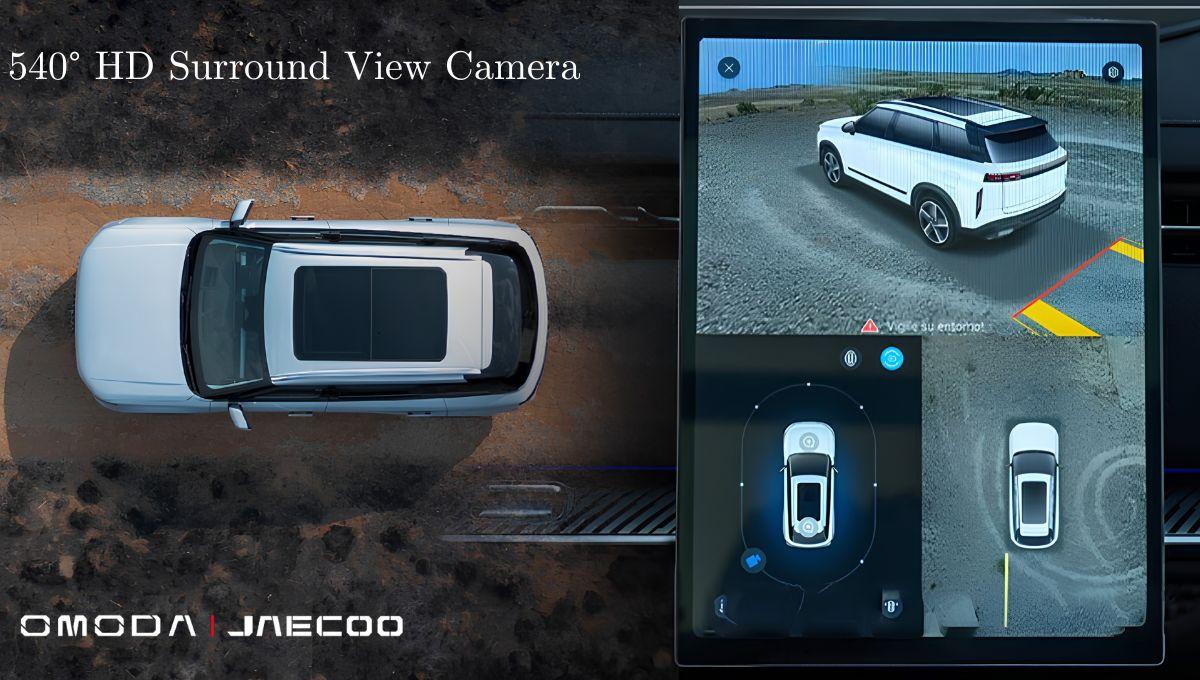
Parking, reversing, and manoeuvring through narrow spaces can be difficult in busy urban areas. A 540° surround-view or panoramic camera provides a broader view around the vehicle, helping the driver assess the surrounding area.
The Omoda E5 Pro lists a 540° surround-view camera, while the J6T features a 540° HD panoramic camera. The J5 also highlights a 540° panoramic camera with an underbody view.
This can be particularly useful for families because city driving, parking, and tight manoeuvring are often part of the same journey as highway travel.
Omoda Jaecoo safety features are not limited to ADAS.
Depending on the model and specification, the wider package can include airbags, electronic stability systems, traction control, tyre-pressure monitoring and electronic braking systems.
The difference is important:
ADAS helps the driver respond to certain situations, while passive safety systems are designed to help protect occupants if a collision occurs.
Families should therefore evaluate the complete safety package instead of focusing only on the number of ADAS functions.
Our EV safety guide for Nepal covers other safety and ownership considerations for electric vehicles.
For families, safety is not only about avoiding a collision. It is also about reducing unnecessary driver workload during long journeys.
A driver travelling with children may be managing traffic, changing road conditions, long distances, and passenger distractions at the same time. Driver-assistance technology can provide an additional layer of support.
|
Driving situation |
Relevant feature |
|
Sudden slowing ahead |
FCW + AEB |
|
Unintentional lane drift |
LDW + LDP/Lane Keep Assist |
|
Long highway cruising |
ACC |
|
Slow-moving traffic |
TJA |
|
Vehicle in a monitored blind spot |
BSD/BSW |
|
Recognizable road signs |
TSR on equipped models |
|
Tight parking and reversing |
540° surround-view camera |
|
Driver-awareness support |
Driver monitoring on equipped models |
The technology is intended to provide warnings, assistance, and, in certain situations, intervention. It does not make the vehicle autonomous or guarantee accident prevention.
Yes, but its performance depends on operating conditions.
Nepali roads can involve motorcycles, pedestrians, changing traffic density, sharp bends, rain, road repairs and inconsistent lane markings. These factors can affect how effectively certain assistance systems detect lanes, vehicles, or road information.
Drivers should never assume that ADAS will detect every obstacle or respond to every situation.
This is why technology should be combined with good driving habits: appropriate speed, safe following distance, regular mirror checks, and continuous attention.
Our guide to Jaecoo on Nepali roads looks at how features such as ADAS, the 540° camera, ground clearance and other equipment support different road conditions.
The Omoda E5 Pro lists 19 ADAS systems, including ACC, AEB, FCW, LDW, LDP, BSD and TJA, together with a 540° surround-view camera.
It is a strong option for buyers who want a technology-focused electric SUV with a broad driver-assistance package.
The Jaecoo J5 offers an L2+ driver-assistance package including ACC, LDW, Lane Keep Assist, AEB, Blind Spot Detection, Traffic Sign Recognition and driver-monitoring functions. It also features a 540° panoramic camera with an underbody view.
The J6T combines ADAS features such as ACC, AEB, Blind Spot Detection, LDW, LDP, and TJA with a 540° HD panoramic camera.
Its assistance technology can be considered alongside its other equipment when evaluating it for mixed urban, highway and more demanding road use.
Because equipment varies by model and local specification, buyers should confirm the latest Nepal specification before purchasing.
Do not assume an international specification applies to the Nepal-market vehicle.
ACC, AEB, LDP, Lane Keep Assist and BSD perform different functions. Understanding each one helps you determine what matters for your driving.
Check visibility, seating position, camera views, controls and the overall driving experience.
Camera- and sensor-based systems need proper maintenance. Ask about servicing and calibration support before buying.
Our guide to EV after-sales service in Nepal explains what owners should consider beyond the initial purchase.
Consider ADAS alongside airbags, braking, stability control, tyres and other vehicle safety systems.
Overall, Omoda Jaewoo ADAS is designed to improve driver awareness and confidence rather than replace attentive driving.
Omoda Jaecoo ADAS is more a system that provides driver assistance rather than taking the place of the driver.
For the family driving along the Nepali roads, some of the features which can give them warnings or assistance in certain situations are AEB, FCW, ACC, LDW, LDP, BSD, and TJA. Surround-view camera technology provides additional visibility when parking and manoeuvring.
It's not just the number of technologies a vehicle offers; it's the question of how those features can help your routes, driving style and family needs.
For buyers comparing options, you can explore Omoda and Jaecoo models and current prices, learn more about EV charging in Nepal, or book a test drive.
Omoda Jaecoo ADAS refers to Advanced Driver Assistance Systems that use cameras, sensors and vehicle-control technology to provide warnings, assistance or intervention in specific driving situations.
The current Nepal model page lists 19 ADAS systems, including ACC, Automatic Braking, FCW, LDW, LDP, BSD and Traffic Jam Assist.
Yes. ACC is included in the Omoda E5 Pro, Jaecoo J5 and J6T in current Nepal market information.
Yes. Automatic Braking or AEB is listed among the safety-assistance features of the E5 Pro, J5 and J6T.
Yes. Blind Spot Monitoring or Blind Spot Detection is listed for the E5 Pro, J5 and J6T.
There are 540° camera features in each of the E5 Pro, J5 and J6T, even though the term 540° and the presentation is different.
Although ADAS can help to minimize risk, it is not always capable of preventing an accident. Drivers must remain attentive and follow safe-driving practices.
Different ADAS features address different driving situations. For highway users, the most relevant technologies are collision warning and braking systems, lane assistance, adaptive cruise control, and blind-spot monitoring.
The combination of ADAS, active safety systems, and surround-view cameras can provide additional support during long journeys. The overall safety of the road system still relies upon road conditions, maintenance, driver behavior, and the current capabilities of each component of the system.