EV Loan & Financing for Premium SUVs in Nepal: Omoda Jaecoo EMI Guide
September 18, 2026
EV Loan & Financing for Premium SUVs in Nepal: Omoda Jaecoo EMI Guide
September 18, 2026
Under the current 60% LTV ceiling, a buyer using the maximum permitted financing would contribute to the remaining 40%.
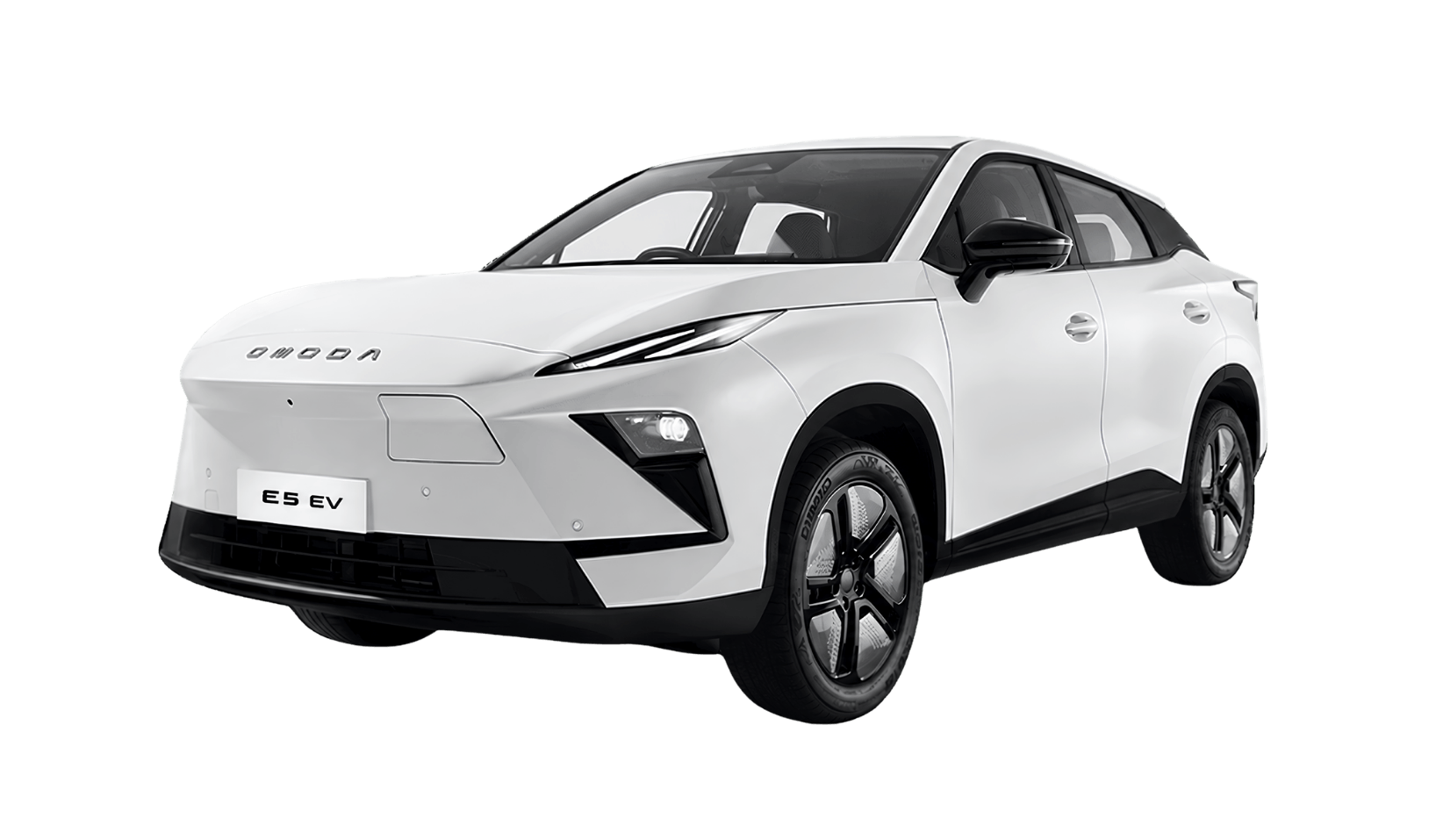
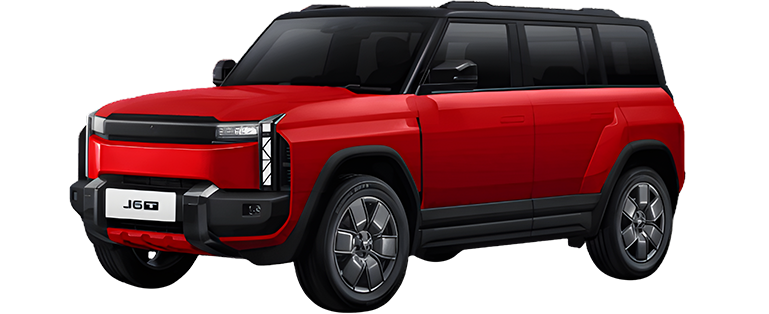
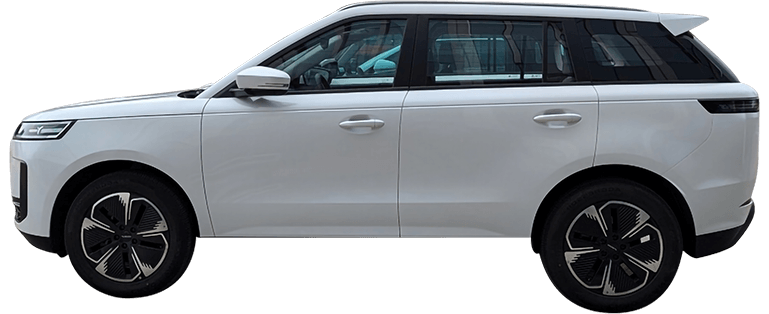
Our current price page lists the OMODA E5 Pro at NPR 51,59,000, E5 Pro Dual Tone at NPR 51,99,000, JAECOO J5 Pro at NPR 51,59,000, JAECOO J5 FWD at NPR 56,99,000, and JAECOO J6T at NPR 69,99,000.
According to Current bank, the interest rates for EV loans are different among different lenders, EV owners, and loan types. For instance, Global IME offers fixed-rate ranges for EV up to 8.99% and financing up to 60% of the vehicle price.
Longer loan duration can lower the monthly EMI but will add up to interest.
Your upfront budget should include more than the down payment: registration, insurance, processing and other applicable charges may also apply.
Rather than the lowest advertised EMI, we suggest that you compare the total repayment amount to determine the repayment cost.
Purchasing a premium electric SUV in Nepal goes beyond just picking the right model. For a lot of buyers, the bigger concern is how much should I pay up-front, how much will my EMI be, and which financing plan will suit my monthly budget?
At OMODA & JAECOO Nepal, we understand that an EV purchase involves more than the showroom price. The overall cost of ownership can vary depending on the down payment, the length of the loan, the interest rate, insurance, registration, and the monthly repayment amount.
Currently, the maximum limit of the loan-to-value (LTV) ratio for personal vehicles and electric vehicles is 60% in Nepal Rastra Bank. If a buyer was financing the full 60%, then the remaining 40% would be their contribution.
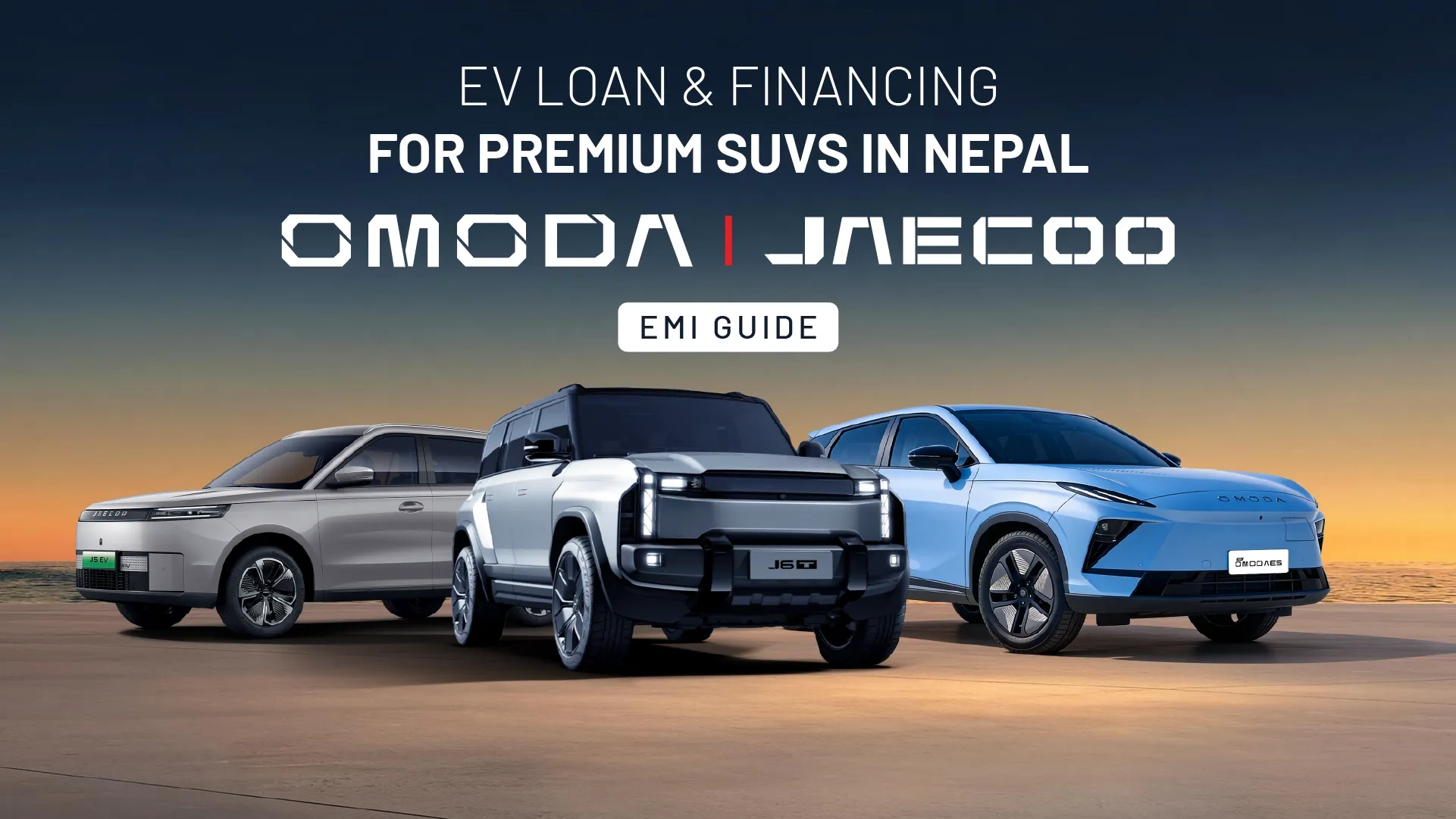
In this EV financing in Nepal guide, we explain how the financing structure works, what affects your EV EMI, how much upfront cash you may need, and what illustrative monthly payments could look like for our OMODA E5 Pro, JAECOO J5 and JAECOO J6T.
Note: EMI figures in this article are illustrative calculations, not guaranteed OMODA & JAECOO financing offers. The amount of loan, interest rate, loan tenure, cost of loan, and loan eligibility are based on the lender's standards.
An EV loan in Nepal generally works like an auto loan. You pay a portion of the car's value, and the lender pays the value that you're eligible for.
The key factor is the 60% LTV limit on personal vehicles and electric vehicles. In this case, for a vehicle cost of NPR 50 lakh, the maximum financing amount under the 60% LTV structure would be NPR 30 lakh while the amount of NPR 20 lakh would be paid by the buyer.
The 60% financing is a maximum; however, it is not guaranteed. A bank might allow a lower loan amount depending on the income, existing obligations, credit profile, valuation of the vehicle, and the banking policy of the bank.
In that case, the 40% mark is used as the buyer contribution in a max financing scenario.
Under the current LTV framework, if you finance the maximum allowable amount of 60%, you will be required to contribute around 40% of the applicable financed vehicle value.
Using our current listed prices, the indicative figures are:
|
Model |
Current listed price |
40% buyer contribution |
60% financing |
|
OMODA E5 Pro |
NPR 51,59,000 |
NPR 20,63,600 |
NPR 30,95,400 |
|
OMODA E5 Pro Dual Tone |
NPR 51,99,000 |
NPR 20,79,600 |
NPR 31,19,400 |
|
JAECOO J5 Pro |
NPR 51,59,000 |
NPR 20,63,600 |
NPR 30,95,400 |
|
JAECOO J5 FWD |
NPR 56,99,000 |
NPR 22,79,600 |
NPR 34,19,400 |
|
JAECOO J6T |
NPR 69,99,000 |
NPR 27,99,600 |
NPR 41,99,400 |
Our current OMODA & JAECOO prices in Nepal page lists the latest model prices. Because prices and offers can change, we recommend checking the live page before applying for financing.
Depending on how much your lender finances (less than 60%) or applies a valuation (which might not be the listed retail price), the amount you need upfront may vary.
In Nepal, there is no fixed EV loan interest rate for all buyers.
The rate will differ from lender to lender, borrower to borrower, loan type to loan type and whether the loan is fixed or floating.
For example, Global IME's current Green Drive product advertises EV financing of up to 60% of vehicle price. It currently offers fixed rates ranging from 6.99% to 8.99% for up to 5 years and 7.24% to 8.99% for up to 7 years, depending on the category of customers. Also it offers a hybrid structure that includes a fixed introductory period followed by a floating Base Rate + 2%.
This is the reason why you need to compare:
Interest rate + fixed/floating structure + processing charges + prepayment terms.
When selecting a bank, don't pick one based on the lowest initial rate.
Your monthly EV EMI in Nepal mainly depends on:
Loan amount + interest rate + loan tenure
For the examples below, we use an illustrative 8% annual interest rate and the maximum 60% financing scenario. The calculations use a standard reducing-balance EMI method.
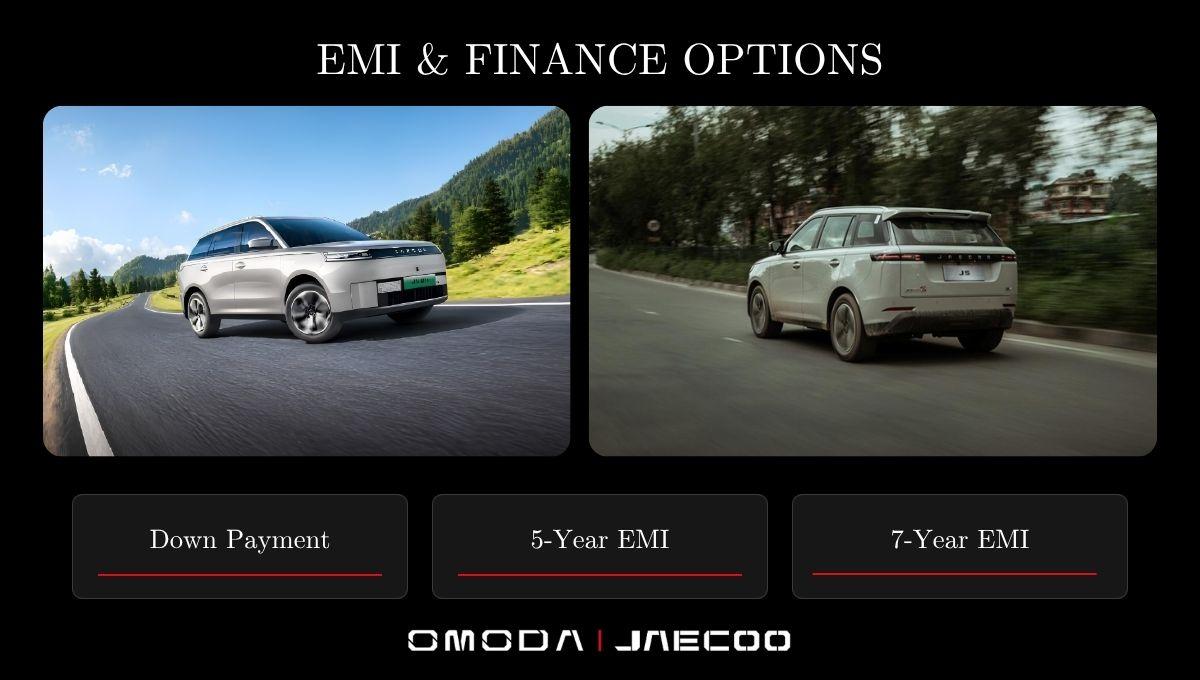
The current listed price of the OMODA E5 Pro is NPR 51,59,000.
With 40% buyer contribution:
Down payment: NPR 20,63,600 Loan amount: NPR 30,95,400
|
Loan tenure |
Illustrative EMI at 8% |
|
5 years |
~NPR 62,764/month |
|
7 years |
~NPR 48,246/month |
For more details about the vehicle itself, see our OMODA E5 Pro price and 2026 guide.
Our official E5 Pro page also provides the model's current features, cabin technology, and driver-assistance information.
Our current price page lists the JAECOO J5 FWD at NPR 56,99,000.
With 40% buyer contribution:
Down payment: NPR 22,79,600 Loan amount: NPR 34,19,400
|
Loan tenure |
Illustrative EMI at 8% |
|
5 years |
~NPR 69,333/month |
|
7 years |
~NPR 53,296/month |
Read our JAECOO J5 price and financing guide for a closer look at the model and ownership considerations.
Our current price page lists the JAECOO J6T at NPR 69,99,000.
With 40% buyer contribution:
Down payment: NPR 27,99,600 Loan amount: NPR 41,99,400
|
Loan tenure |
Illustrative EMI at 8% |
|
5 years |
~NPR 85,149/month |
|
7 years |
~NPR 65,453/month |
If you are comparing the two SUVs before you make a purchase, the specs guide for JAECOO J5 vs J6T is helpful.
The decision between a 5-year loan and a 7-year loan comes down to a balance between monthly payments and financing costs.
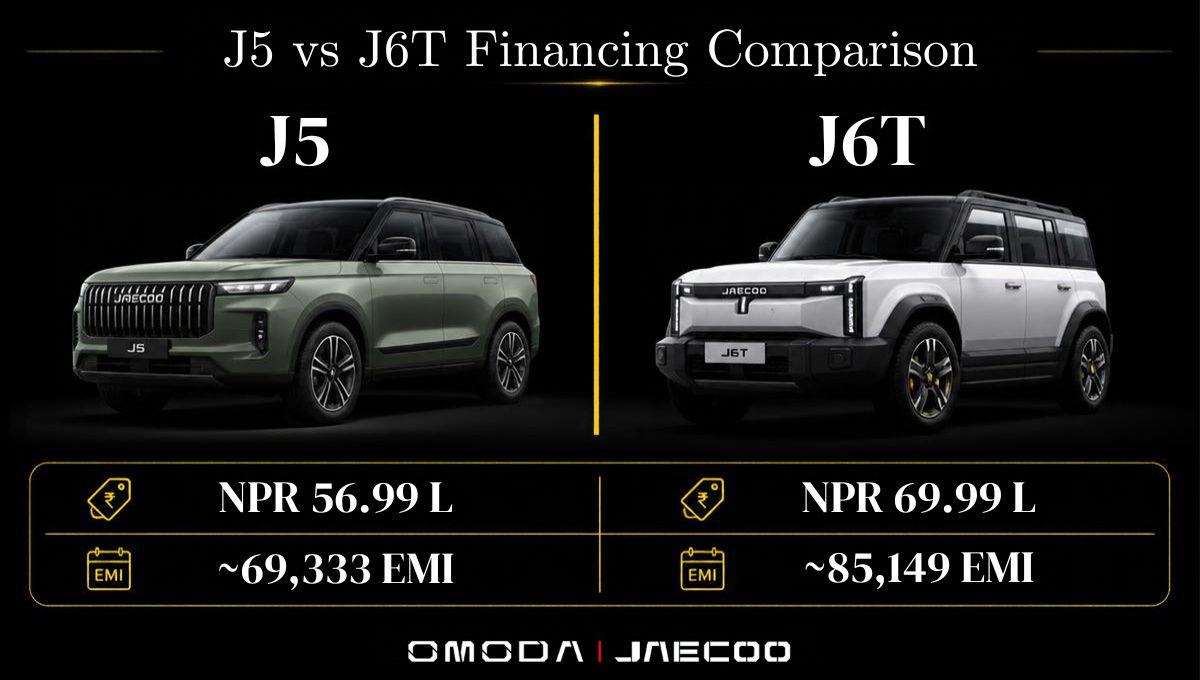
A five-year loan will offer a greater EMI each month and lower interest overall.
A seven-year loan will typically result in a lower monthly EMI but will extend the tenure of the loan and lead to higher interest payments.
For the JAECOO J5 at the illustrative 8% rate:
5 years → ~NPR 69,333/month
7 years → ~NPR 53,296/month
The advantage of the seven-year option is that the monthly payment is reduced by about NPR 16000, but it also has a higher total interest cost.
The advantage of the seven-year option is that the monthly payment is reduced by about NPR 16000, but it also has a higher total interest cost.
Your EV down payment in Nepal is not necessarily your complete upfront purchase cost.
Depending on your transaction and lender, you may also need to budget for:
Vehicle registration and applicable government charges
Insurance
Loan processing charges
Valuation or administrative fees
Documentation charges
Other lender or transaction-related costs
Home-charging equipment or installation, where required
Our OMODA E5 Pro price guide also explains the difference between the listed vehicle price and potential on-road expenses.
Exact EV loan eligibility and documentation depend on the lender and applicant.
A bank may ask for documents relating to:
Citizenship or other valid identity documents
Income or salary verification
Bank statements
Employment or business information
Tax or business documents for self-employed applicants
Details of existing loan or liability
Vehicle quotation or pro forma invoice
For example, Global IME's Green Drive product requires applicants to be Nepalese citizens above 21 or eligible registered entities and to have sufficient income and cash flow to service the debt.
Please be sure to review the lender's specific list prior to applying.
Whether electric vehicle financing in Nepal makes financial sense depends on your budget, financing cost, expected ownership period and running expenses.
An EV might be more competitive in terms of running costs, due to cheaper charging and maintenance compared to petrol-powered models. Our OMODA & JAECOO EV charging cost guide estimates charging costs across home, NEA and private DC charging and explain how battery size and charging method affect the total.
The more appropriate financial comparison is, rather:
“What is my EMI?”
It is:
“What will my upfront payment, EMI, charging, maintenance and total financing cost look like over the period I plan to own the SUV?”
You can also explore our guide to Nepal's EV charging network to plan longer journeys and understand available charging locations.
Before applying for an EV loan in Nepal, we recommend checking five things:
Down payment: Will you be able to afford the initial upfront?
EMI: Does the monthly payment fit your regular budget?
Interest structure: Is the rate fixed, floating or hybrid?
Total repayment: How much will you repay by the end of the loan?
Extra charges: What processing, insurance, registration or other costs apply?
A lower EMI does not necessarily mean a lower total financing cost. The optimal plan is the one that you can afford monthly and keeps the total financing cost to a minimum.
While driving priorities are important, we at OMODA & JAECOO Nepal think that financial planning is also crucial when you are selecting for a premuim electric SUV.
With the current 60% LTV ceiling, the buyer financing at the maximum would be expected to contribute 40%.
Based on our current listed prices, that is approximately:
OMODA E5 Pro → NPR 20.64 lakh
JAECOO J5 → NPR 22.80 lakh
JAECOO J6T → NPR 28.00 lakh
From there, your actual EV EMI in Nepal will depend on the lender's approved interest rate, loan amount and tenure.
Explore our current OMODA & JAECOO prices in Nepal, learn more about the OMODA E5 Pro, JAECOO J5 and JAECOO J6T, or book a test drive with us before making your final purchase decision.
With the current 60% LTV cap, the buyer would need to put up 40% on the remaining 60% of the purchase price. Depending on their assessment, a lender may approve a lesser loan amount.
Different borrowers are charged at different rates. These rates vary based on the lender, customer profile, and loan type. For instance, Global IME's latest Green Drive product offers EV fixed rate ranges up to 8.99% and financing up to 60% of vehicle value.
The estimated EMI is around NPR 62764 per annum for 5 years or NPR 48246 per annum for 7 years at an illustrative rate of 8% at current NPR 51,59,000 listed price, with 60% financing.
Assuming an illustrative 8% interest rate, the estimated EMI for the current listed price of NPR 56,99,000 is around NPR 69,333 for five years and NPR 53,296 for seven years.
The estimated EMI at illustrative 8% annual rate is around NPR 85,149 for 5 years (or NPR 65,453 for 7 years) for financing about 60% of the current list price of NPR 69,99,000.
Under the current regulatory regime, 100% vehicle-price financing is not offered under the current LTV ceiling of 60%, for personal vehicles and EVs. A lender can still decide on the amount for approval.
Some banks offer EV financing terms extending to seven years. Global IME's current Green Drive product has published fixed-rate EV financing options for up to seven years.
The 7-year loan period generally reduces the monthly premiums whilst boosting the overall sum paid in interest. A five-year mortgage tends to have a greater total interest but lowers monthly payment.
These requirements will differ from lender to lender, but may include identification, income verification, bank statements, vehicle quotation, employment, business or existing liability documents.
You should compare it. EMI indicates what you will pay monthly, and total repayment indicates the total cost of financing the loan. Lowering the EMI of a loan could be more expensive over the life of the loan.